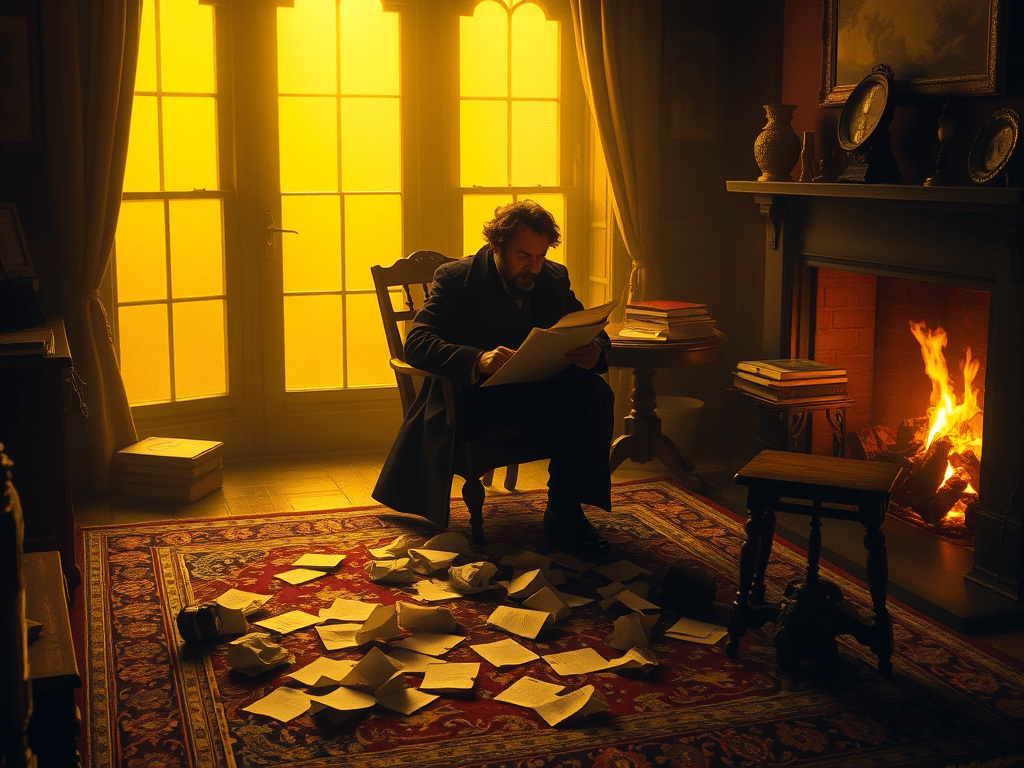
The fog pressed against the windows of Tavistock House like a living thing, thick and yellow as mutton broth. Charles Dickens sat hunched over his writing desk, the manuscript of Little Dorrit spread before him like a battlefield map where no victory could be claimed. The clock had long since struck midnight, yet sleep remained as elusive as the proper words to carry poor Arthur Clennam through his next tribulation.
“Confound it all!” Dickens muttered, crumpling another sheet of foolscap and hurling it toward the fireplace. The paper ball joined a dozen others scattered across the Persian rug—each one a failed attempt to breathe life into what should have been a simple scene. Arthur was to meet his mother. Nothing more. Yet the words sat upon the page like lead weights, refusing to dance with their customary vigor.
For three days now, the dreaded malady had possessed him. That terrible affliction which strikes down writers as surely as consumption strikes down seamstresses—the complete and utter absence of inspiration. His characters, usually as real to him as his own children, had become mere shadows. His voice, which could move thousands to tears or laughter in public readings, had withered to a whisper.
The fire crackled its sympathy, casting dancing shadows across the room. Dickens rose abruptly, disturbing the cat that had been keeping vigil beside his inkwell. Perhaps a walk might jar loose whatever had seized his imagination so cruelly. He had always been a great walker, finding in London’s streets the very pulse of life that animated his stories.
Wrapping himself in his greatcoat, Dickens stepped into the foggy embrace of the night. The gas lamps emerged and vanished like uncertain stars, and his footsteps echoed against the cobblestones with hollow authority. He walked without purpose, letting his feet carry him through the maze of streets that had birthed Oliver Twist and Scrooge, that had witnessed the transformation of Sydney Carton and the resurrection of John Harmon.
It was in Drury Lane that he first heard the scraping sound—rhythmic, persistent, like a clock that had forgotten how to tick properly. As he drew closer, the fog parted to reveal a figure bent over a broom, methodically sweeping the street despite the late hour. The man was ancient, his back curved like a question mark, his clothes patched with such artistry that poverty had been transformed into a kind of dignity.
“Good evening to you,” Dickens called out, his curiosity overcoming the lateness of the hour.
The old man straightened slowly, revealing a face mapped with lines that spoke of seven decades of hard-won wisdom. His eyes, however, sparkled with an alertness that belied his years.
“Evening, sir. Though I’d venture it’s more morning than evening by now,” the sweeper replied, his voice carrying the educated cadence of a man who had seen better circumstances. “You’re about late for a gentleman of your station.”
“I might say the same of you,” Dickens replied, drawing nearer. “Surely the streets will wait until dawn for their cleaning?”
The old man chuckled, a sound like dry leaves rustling. “Ah, but that’s where you’d be wrong, sir. The best work—the truest work—it happens when the world sleeps. When all the noise and bustle dies away, that’s when you can hear what the streets are really saying.”
Something in the man’s manner stirred Dickens’s professional interest. Here was a character worth knowing, though he felt no urge to commit him to paper. The creative paralysis still held him fast.
“And what do the streets say to you tonight?” Dickens inquired.
The sweeper paused in his work, leaning on his broom handle. “They tell me stories, sir. Every piece of refuse, every mark on the cobblestones—it’s all a story. Take this morning’s collection.” He gestured to a small pile of debris. “Here’s a handkerchief with fine embroidery, dropped by a lady in distress. There’s a child’s marble, lost in play. And this”—he held up a torn piece of paper—“this is someone’s unfinished letter, cast away in frustration.”
Despite himself, Dickens found his attention sharpening. “You read stories in rubbish?”
“I read stories in everything, sir. The trick isn’t finding them—they’re everywhere, thick as this fog. The trick is learning to see them when your eyes are tired, when your heart’s heavy, when you think the well has run dry.”
The words struck Dickens with unexpected force. “And how does one accomplish such a trick?”
The old man’s smile was knowing. “Why, you do what I do, sir. You start small. You pick up one thing—just one—and you ask it to tell you its story. Not the story you want to hear, mind you, but the story it wants to tell. Then you listen. Really listen. And once you’ve heard that story, you pick up another thing, and another. Before you know it, you’ve got enough stories to last a lifetime.”
As if to demonstrate, the sweeper bent and retrieved a brass button from the gutter. “Now this little fellow here—he’s been torn from a coachman’s uniform, I’d wager. See the wear pattern? He’s seen years of service. But tonight, he’s lost his purpose. Tomorrow, some resourceful soul will find him, and he’ll become part of something new. A different story entirely.”
Dickens stared at the button, and for the first time in days, he felt the familiar stirring of imagination. Not the forced, desperate grasping he’d been attempting at his desk, but something gentler, more organic. The button became a character in his mind’s eye—not just an object, but a repository of experience, a witness to countless journeys.
“You’re a writer,” the old man said, and it wasn’t a question.
“I am. Or I was. I’ve been… struggling of late.”
“Ah.” The sweeper nodded sagely. “Been trying to force the river to flow uphill, have you?”
The metaphor was so perfectly apt that Dickens felt exposed. “Something like that.”
“See, that’s where most folks go wrong. They think inspiration is something you catch, like a runaway horse. But it’s not. It’s something you cultivate, like a garden. You tend it daily, you water it with attention, you pull the weeds of doubt. And sometimes, when you’re patient enough, it blooms.”
The old man resumed his sweeping, but his words continued to flow. “The trouble comes when you expect every day to be blooming day. When you demand that the roses open just because you’re ready to see them. But gardens don’t work that way, sir. Some days you plant, some days you water, some days you just sit and watch the soil. All of it matters. All of it’s part of the growing.”
Dickens found himself walking alongside the sweeper, matching his methodical pace. “But surely there are times when the garden seems barren? When nothing will grow no matter how you tend it?”
“Oh, certainly. But that’s when you do what I’m doing right now. You clean the ground. You clear away the debris, the old leaves, the things that have served their purpose. You make space for new growth. And while you’re cleaning, you keep your eyes open. You stay curious. You let the small things speak to you.”
They worked in comfortable silence for a while, Dickens finding himself oddly soothed by the simple rhythm of the broom. The fog began to thin, revealing the first pale hints of dawn in the eastern sky.
“I should return to my work,” Dickens said finally, though he was reluctant to leave this strange, wise companion.
“Course you should,” the sweeper agreed. “But remember what I told you. Start small. Pick up one thing—one character, one moment, one feeling—and let it tell you its story. Don’t try to write the whole novel at once. Just write what’s in front of you. The rest will come.”
As Dickens walked back toward Tavistock House, the old man’s words echoed in his mind. But more than that, he found himself truly seeing the street for the first time in days. Here was a sleeping cat, curled in a doorway—what dreams might visit such a creature? There was a milk cart, already beginning its rounds—what stories might its driver tell? And there, in a lighted window, a woman in a nightgown held a crying child—what desperate love, what midnight fears, what hopes for the morning?
By the time he reached his study, Dickens was no longer thinking about Arthur Clennam’s meeting with his mother. Instead, he was thinking about a brass button, lost and found, and the countless hands that had polished it to brightness. He dipped his pen in the inkwell and began to write—not the scene he’d been struggling with, but something new entirely. A small scene, seemingly insignificant, about a character discovering a button in the street and the memories it triggered.
The words flowed like water finding its course, each sentence building naturally upon the last. He wrote about small discoveries, about the stories hidden in ordinary objects, about the way attention could transform the mundane into the magical. And as he wrote, he felt the familiar joy returning—not the desperate joy of a man clutching at inspiration, but the quiet joy of a craftsman at work, trusting in his tools and his training.
When he finally looked up, the sun was streaming through his windows, and he had written five pages. Not the five pages he’d intended, but five pages nonetheless. Good pages. True pages.
The creative block had not been conquered through force or desperation, but through the simple act of paying attention. Of listening. Of allowing the small things to speak their truth before demanding that the large things do the same.
And in the distance, he could swear he heard the gentle scraping of a broom, preparing the ground for new growth.
The next morning, Dickens returned to Arthur Clennam’s scene with fresh eyes. The character who had been so stubbornly silent suddenly had volumes to say. For Dickens had learned anew what he had always known but sometimes forgot: that the writer’s greatest tool is not inspiration, but attention. And attention, unlike inspiration, is always available to those patient enough to cultivate it.
Make a one-time donation
Make a monthly donation
Make a yearly donation
Choose an amount
Or enter a custom amount
Your contribution is appreciated.
Your contribution is appreciated.
Your contribution is appreciated.
DonateDonate monthlyDonate yearly The Muse Be Willing
Leave a comment