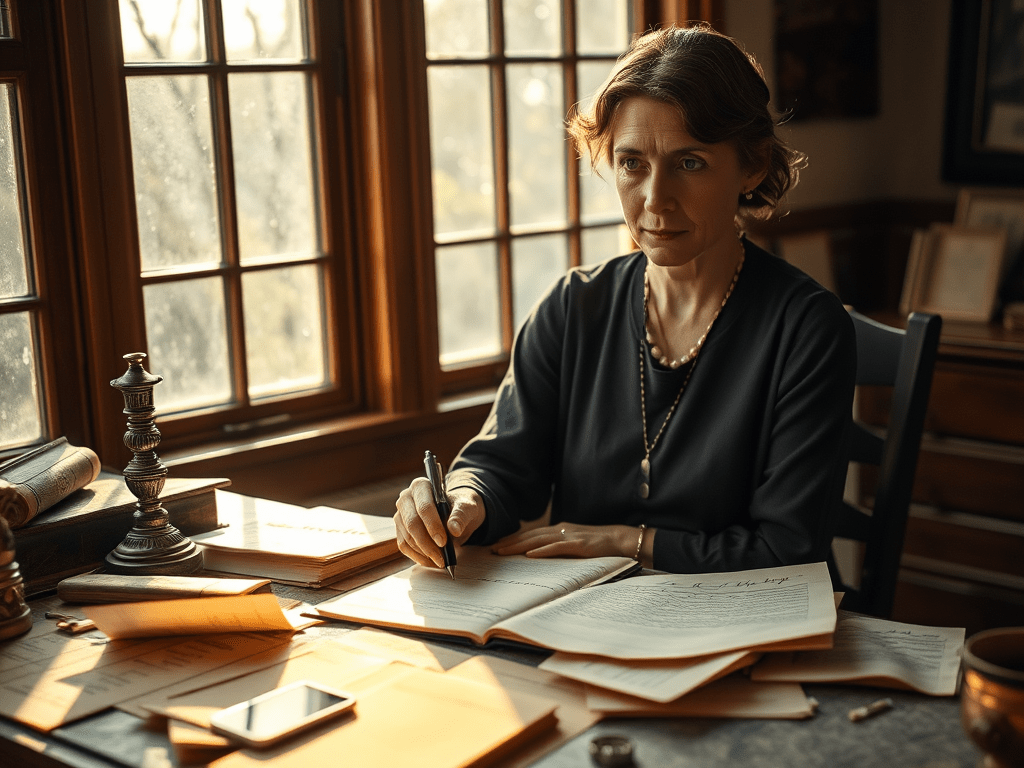
The morning light filtered through the windows of the writing lodge at Monk’s House, casting long shadows across Virginia Woolf’s desk where pages of manuscript lay scattered like autumn leaves. She sat motionless, fountain pen suspended above the foolscap, her mind a peculiar battlefield where thoughts arrived and departed with the frantic energy of commuters at Victoria Station.
*Ping.*
The sound existed only in her imagination, yet it jolted her from the sentence she’d been constructing about Clarissa Dalloway’s morning walk. Where had that sound come from? There was no bell, no telephone, no servant approaching. Yet the phantom notification had shattered her concentration as surely as if someone had burst through the door shouting urgent news.
She set down her pen and pressed her palms against her temples. This was the third time this morning that her attention had been hijacked by sounds that weren’t there, by the sensation that somewhere, somehow, something required her immediate response. It was as if her mind had become a drawing room where uninvited guests constantly arrived, each demanding acknowledgment, each fragmenting her thoughts into smaller and smaller pieces.
The condition had begun subtly, perhaps a month ago. At first, she’d attributed it to the usual writerly anxieties—the fear that her work on *Mrs. Dalloway* was not progressing as it should, the worry that her experimental approach to narrative time was too radical for readers to follow. But this felt different. This felt like her very capacity for sustained thought was being eroded by some invisible force.
She rose and walked to the window, observing the garden where Leonard was working among the roses. His movements were deliberate, unhurried—the embodiment of focused attention. How she envied him that quality now, when her own mind felt like a pond disturbed by too many stones.
*Ping. Ping. Ping.*
Three phantom sounds in rapid succession. Virginia gripped the windowsill, her knuckles white. The sounds seemed to come from everywhere and nowhere, accompanied by a compulsive need to… to what? To respond? To check something? But there was nothing to check, nowhere to respond to.
She returned to her desk and attempted to resume writing, but the words that had once flowed like water now came in stuttering fragments. Each sentence felt interrupted before it could complete itself, as if her attention was a butterfly that could no longer alight on any single flower for more than a moment.
The morning stretched on in this fashion—moments of clarity followed by sudden dispersal, thoughts that began with promise only to dissolve into anxiety about whether she was missing something important, something that required her attention elsewhere. By noon, she had managed only three sentences, each one wrung from her consciousness like water from a stone.
Leonard appeared at the door with tea, his face creased with the particular concern he reserved for her difficult days. “How goes the work, my dear?”
“It doesn’t,” she replied, gesturing at the nearly blank page. “My mind has become a railway station where all the trains arrive at once, and I can’t board any of them.”
He set down the tea tray and settled into the chair beside her desk. “Tell me about it.”
Virginia found herself describing the phantom sounds, the compulsive need to respond to non-existent summons, the way her concentration scattered like startled birds at the slightest provocation. As she spoke, she noticed how the act of articulating her experience seemed to give it shape, to make it less overwhelming.
“It’s as if,” she said, warming to her theme, “as if my mind has become habituated to constant interruption. As if I’ve been living in a great, noisy house where bells ring constantly, and now, even in the silence of this room, I still hear them.”
Leonard nodded thoughtfully. “You’ve been reading the newspapers more frequently of late. Following the political developments, the literary reviews, the society pages. Perhaps that’s contributing to the sense of… fragmentation?”
The observation struck her as profoundly accurate. She had indeed been consuming information with unprecedented hunger in recent weeks—not just the essential news, but every detail, every commentary, every opinion. Her breakfast had become a feast of scattered facts and urgent opinions, each one demanding immediate assimilation.
“But surely,” she protested, “a writer must be informed. Must know what’s happening in the world.”
“Must she know everything that’s happening, the moment it happens?” Leonard asked gently. “Or might there be a difference between being informed and being… overwhelmed?”
Virginia considered this. She thought of the great writers she admired—Jane Austen, who had created enduring art while living in relative isolation; George Eliot, who had absorbed the world deeply but selectively. Had they suffered from this same compulsive need to know everything immediately?
“I think,” she said slowly, “I’ve been trying to hold the entire world in my mind at once. Every opinion, every event, every possible response. And my mind has become like a drawing room where everyone is talking at once, and no one can hear what anyone else is saying.”
That afternoon, Virginia decided to conduct an experiment. She would attempt to write for one hour—sixty minutes—without allowing her attention to wander to anything beyond the immediate task. She would treat her consciousness like a room that she could choose to keep closed to uninvited guests.
The first few minutes were torture. Her mind rebelled against the constraints, generating phantom urgencies and imaginary summons. But gradually, as she persisted in returning her attention to the page, something began to shift. The compulsive need to respond to non-existent calls grew quieter. The phantom sounds became less frequent.
She found herself writing about Clarissa’s morning walk, but now the description was layered with her own recent experience. Clarissa, too, was navigating a world full of competing claims on her attention. The novel began to explore not just the flow of consciousness, but the way that consciousness could be fractured by too many simultaneous demands.
As she wrote, Virginia realized she was discovering something important about the nature of attention itself. The mind, she saw, was not a passive recipient of whatever happened to arrive, but an active force that could be directed, disciplined, shaped. Like a skilled hostess, consciousness could choose which guests to admit to the drawing room and which to politely turn away.
The hour passed without her noticing. When she finally looked up, she had written three full pages—more than she had managed in the entire morning. The words had a quality she hadn’t achieved in weeks: they were connected, flowing, alive with the particular rhythm that marked her best work.
But more than that, she had discovered something about the relationship between attention and creativity. The scattered, anxious awareness that had plagued her morning was not a sign of intellectual vitality, but of intellectual dissipation. True creativity, she realized, required not just the ability to receive impressions, but the ability to select among them, to dwell with them, to allow them to develop and deepen.
That evening, she walked in the garden with Leonard, sharing her discovery. “I think,” she said, “that I’ve been confusing being aware of everything with being truly aware of anything. I’ve been like someone trying to have a hundred conversations at once, and hearing none of them properly.”
“And now?” Leonard asked.
“Now I think I understand that attention is not a net to catch every passing thought, but a lamp to illuminate deeply whatever it chooses to shine upon. The art is not in capturing every possible impression, but in choosing which impressions deserve the full light of consciousness.”
The next morning, Virginia established a new routine. She would begin each day not by consuming information, but by sitting quietly in the garden for ten minutes, allowing her mind to settle like silt in still water. She would read the newspaper, but only after her writing was complete, and only for a limited time. She would treat her consciousness as a precious resource to be allocated intentionally, rather than a receptacle to be filled indiscriminately.
The phantom sounds—those imaginary notifications that had plagued her—began to fade. Not because the world had become less demanding, but because she had learned to distinguish between genuine calls for attention and the mind’s habitual restlessness. She had discovered that the stream of consciousness, to be truly explored, required not just sensitivity to impressions, but the discipline to dive deeply into selected currents rather than skimming frantically across the surface.
Her work on *Mrs. Dalloway* resumed with renewed vigor. But now the novel carried within it a deeper understanding of the modern condition—the way that consciousness itself was under siege from the multiplying demands of an accelerating world. Through Clarissa’s experience, she would explore how the mind could maintain its integrity while remaining open to the richness of human experience.
The drawing room of the mind, Virginia had learned, was most beautiful when it was neither empty nor overcrowded, but thoughtfully curated—a space where carefully chosen impressions could be received with the full hospitality of deep attention.
—–
*In the weeks that followed, Virginia’s writing took on a new depth and focus. She had learned that the modern writer’s greatest challenge was not finding material to write about, but learning to write despite the constant pressure to attend to everything at once. The solution was not to shut out the world, but to engage with it more selectively, more intentionally, more deeply.*
Make a one-time donation
Make a monthly donation
Make a yearly donation
Choose an amount
Or enter a custom amount
Your contribution is appreciated.
Your contribution is appreciated.
Your contribution is appreciated.
DonateDonate monthlyDonate yearly/
 The Muse Be Willing
Leave a comment