Author: The Muse Be Willing

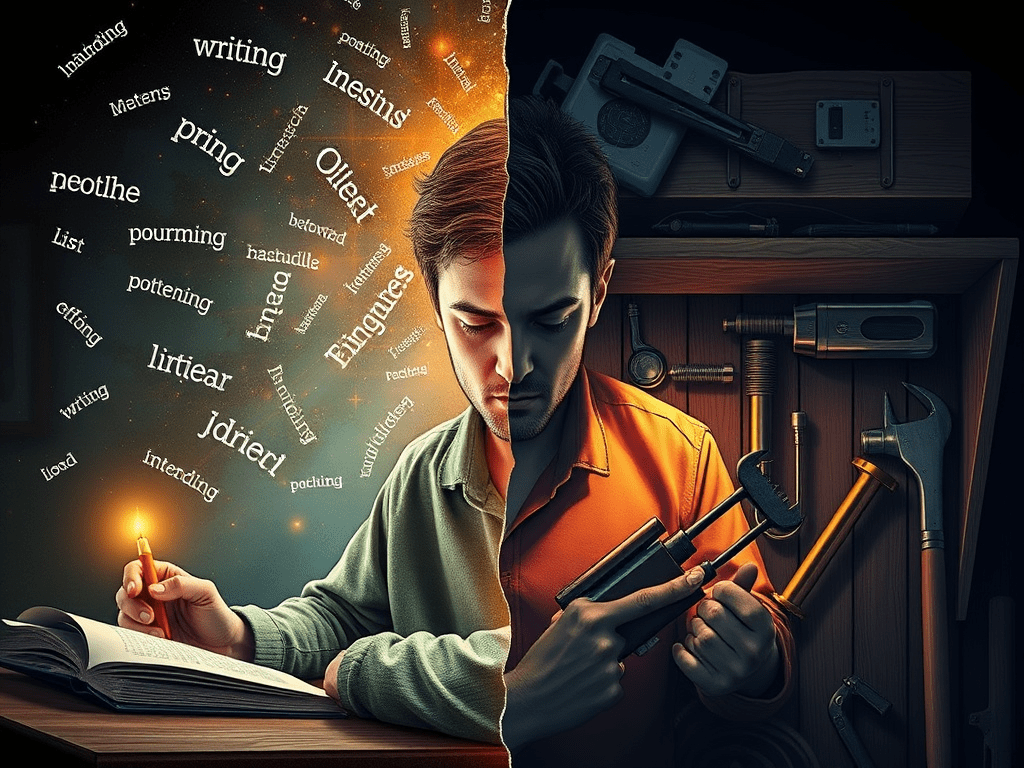
  • The Creative Brain in Transition: Why Switching Tasks Can Sometimes Feel…Well, Dumb

    The Creative Brain in Transition: Why Switching Tasks Can Sometimes Feel…Well, Dumb


    As creatives, we often wear many hats. One moment we’re lost in the flow of writing a compelling scene, the next we might be sketching out a visual concept, and later in the day, perhaps we’re even tackling a more practical task like fixing a wobbly shelf. This constant shifting of gears is part of what makes creative life so dynamic, but have you ever noticed that moment of mental clunkiness when you transition between these vastly different activities? That fleeting feeling of, “Wait, my brain isn’t working for this right now”?
    You’re not alone. It’s not about a sudden drop in your overall intelligence; it’s about how your amazing brain handles the cognitive demands of switching tasks.
    The Brain’s Creative Shuffle: More Like an Orchestra Tuning Than Flipping a Switch
    Forget the image of your brain having separate compartments for “writing smarts” and “fixing things smarts.” It’s much more intricate than that. When you move from crafting prose to, say, learning a new dance step or troubleshooting a tech issue, your brain is more like an orchestra re-tuning its instruments. Different activities require different sections of the brain to play more prominently:

    • From Words to Movement: Writing engages your language centers, working memory, and the executive functions that help you structure your thoughts. Dancing, on the other hand, lights up your motor cortices for planning movement, your cerebellum for coordination, and the basal ganglia for fluidity. It’s a shift from linguistic prowess to bodily-kinesthetic intelligence taking center stage.
    • Abstract to Concrete: Fixing something tangible, like a car or that shelf, demands a different kind of focus. It often involves spatial reasoning, problem-solving, and accessing practical, hands-on knowledge. Your brain is switching from the abstract world of ideas in writing to the concrete world of mechanics or construction.
      The “Dumb” Feeling: It’s Not You, It’s the Transition Tax
      That moment of feeling a little lost or less capable when you switch isn’t a reflection of your inherent abilities. It’s often due to something called task-switching cost. Think of it as a small tax your brain has to pay each time it changes gears. This involves:
    • Disengaging from the Old: Your brain needs a moment to let go of the neural pathways and cognitive processes it was using for the previous task.
    • Engaging with the New: It then has to activate the specific networks and recall the knowledge needed for the new activity.
      This transition isn’t instantaneous. There’s a brief period where your mental gears might feel like they’re grinding or not quite meshing.
      Why the Hesitation? Interference and Recall Time
      You might also experience:
    • Interference: The mental habits and processes from your previous task can sometimes get in the way of the new one. That analytical, critical mindset you use for editing your writing might initially feel like a hindrance when you’re trying to let loose and move freely in dance.
    • Skill Retrieval Time: It simply takes a moment for your brain to pull up the right “files” – the specific skills and knowledge required for the new task.
      Embrace the Transition: It’s Part of the Creative Journey
      The good news is that this feeling is normal, and it doesn’t mean you’re not capable. It simply highlights the incredible flexibility of your brain as it adapts to different demands. Recognizing this process can actually be liberating. Instead of feeling frustrated by that initial awkwardness, you can see it as a natural part of your creative journey.
      Tips for Smoother Creative Gear Shifts:
    • Give Yourself Time: Allow for a brief mental “buffer zone” when switching between vastly different tasks. Don’t expect to go from writing a complex narrative to executing intricate dance moves flawlessly in an instant.
    • Mindful Breaks: Sometimes a short break between tasks can help your brain reset and prepare for the new challenge.
    • Warm-Up: Just like a physical warm-up prepares your body, a brief mental warm-up related to the new task can help your brain get in the zone.
    • Practice Makes Progress: The more you switch between different types of activities, the more efficient your brain can become at these transitions.
      So, the next time you move from the focused world of writing to the expressive realm of dance or the practicalities of fixing something, and you feel that momentary sense of mental disorientation, remember it’s not a sign of being “dumb.” It’s just your brilliant creative brain shifting gears, ready to embrace a new challenge. Embrace the transition, knowing that with a little patience, you’ll find your rhythm in the next creative endeavor.
    One-Time
    Monthly
    Yearly

    Make a one-time donation

    Make a monthly donation

    Make a yearly donation

    Choose an amount

    $5.00
    $15.00
    $100.00
    $5.00
    $15.00
    $100.00
    $5.00
    $15.00
    $100.00

    Or enter a custom amount

    $

    Your contribution is appreciated.

    Your contribution is appreciated.

    Your contribution is appreciated.

    DonateDonate monthlyDonate yearly
  • Morning Pages in the Age of AI: A New Chapter or Digital Detour?

    Morning Pages in the Age of AI: A New Chapter or Digital Detour?


    For years, the practice of morning pages has been a cornerstone for creatives, writers, and anyone seeking clarity and a clearer mind. As outlined by Julia Cameron in “The Artist’s Way,” it’s a simple yet powerful ritual: three pages of longhand, stream-of-consciousness writing done first thing in the morning. No editing, no judgment, just pure thought poured onto the page.
    But in a world increasingly shaped by artificial intelligence, the question arises: What do morning pages look like today? Can AI play a part in this intimate practice, or does it fundamentally change its essence? Let’s explore the possibilities.
    The Rise of AI: Can It Enhance Our Morning Ritual?
    The advancements in AI offer some intriguing ways it could intersect with morning pages:

    • The Power of Voice: AI Transcription. For those who think faster than they can write, or for individuals with physical limitations, AI-powered voice-to-text software could be a game-changer. Imagine speaking your unfiltered thoughts and having them instantly transcribed. The stream of consciousness remains, just the medium shifts.
    • A Gentle Nudge: AI-Powered Prompts. We all have those mornings when our minds feel like a blank slate. While the core of morning pages is free-flowing thought, an AI could offer a subtle nudge. A simple, open-ended prompt like, “What’s weighing on your mind today?” or “Describe a vivid dream you had,” could be enough to get the ink (or digital equivalent) flowing. Think of it as a friendly suggestion, not a replacement for your own thoughts.
    • Reflection, Revisited: AI for Theme Identification (Use with Caution). After you’ve filled your pages, you could theoretically use AI to identify recurring themes, patterns, or dominant emotions. This could offer a detached perspective on your inner world. However, this should be approached with caution. The initial act of writing is about unburdening yourself without judgment, and over-analyzing with AI might disrupt that organic process.
      Staying True to the Spirit: The Core of Morning Pages
      While AI offers some interesting avenues, it’s crucial to remember the fundamental principles of morning pages:
    • Unfiltered Expression: The goal is to let your thoughts flow freely without editing or censoring. This is where AI needs to be used carefully.
    • Personal Connection: The act of physically writing (or even speaking your own words) fosters a unique connection to your thoughts. Relying too heavily on AI to generate content would sever this link.
    • No Judgment: Morning pages are a safe space for your thoughts, no matter how messy or mundane. Introducing AI for editing or evaluation during the process could undermine this crucial aspect.
      Morning Pages in the 21st Century: Evolution or Dilution?
      Ultimately, how AI integrates with morning pages is a personal choice. For some, the traditional pen-and-paper method will always be the most authentic and beneficial. For others, the accessibility and convenience offered by AI tools might open up the practice in new and valuable ways.
      The key is to use AI as a tool to support the core principles of morning pages, not to replace them. Whether you choose to speak your pages to an AI transcriber or occasionally seek a prompt when you’re feeling stuck, the essence remains: a dedicated time to connect with your thoughts, clear your mental clutter, and set yourself up for a more intentional day.
      What are your thoughts? Could AI enhance your morning pages, or do you prefer the traditional approach? Share your perspective in the comments below!
  • The AI-Powered Songwriter’s Toolkit: How Technology is Revolutionizing Music Creation

    The AI-Powered Songwriter’s Toolkit: How Technology is Revolutionizing Music Creation

    The music industry has always been quick to embrace new technology, from the electric guitar to synthesizers to digital recording. Today, we’re witnessing another seismic shift as artificial intelligence and advanced digital tools reshape how songs are conceived, crafted, and brought to life. For the tech-savvy songwriter, this isn’t about replacing human creativity—it’s about amplifying it.

    The Rise of AI-Assisted Creativity

    Modern songwriters are discovering that AI can be their most versatile collaborator. Tools like ChatGPT, Claude, and specialized music AI platforms have become invaluable for brainstorming sessions, helping writers explore new lyrical territories and experiment with rhyme schemes they might never have considered.

    These AI assistants excel at generating initial concepts and breaking through creative blocks. A songwriter might input a theme or emotion and receive dozens of potential angles to explore. The magic happens when human intuition meets artificial intelligence—the AI provides the raw material, while the songwriter shapes it into something meaningful and authentic.

    Specialized AI melody generators and chord progression tools are equally transformative. Rather than staring at a blank page (or screen), songwriters can quickly generate musical foundations to build upon. This rapid prototyping allows for more experimentation in less time, leading to more diverse and innovative compositions.

    Seamless Production Integration

    The line between writing and producing continues to blur, and today’s songwriters are taking advantage of this convergence. Writing directly within a Digital Audio Workstation (DAW) means ideas can be captured with their intended sonic context intact. Real-time collaboration features allow multiple writers to work on the same project simultaneously, regardless of their physical location.

    Voice memos and smartphone apps have become indispensable tools for capturing lightning-in-a-bottle moments. Whether it’s a melody that strikes during a morning jog or a lyrical phrase overheard in conversation, these tools ensure no idea gets lost. The best part? Modern workflows allow for seamless transfer from mobile capture to professional production environments.

    AI-powered mixing and mastering tools have democratized the demo process. Songwriters can now create professional-sounding demonstrations of their work without needing expensive studio time or extensive technical knowledge. This capability is particularly valuable for pitching songs or collaborating with artists remotely.

    Data-Driven Creative Decisions

    While art and analytics might seem at odds, savvy songwriters are finding ways to let data inform—not dictate—their creative choices. Streaming platforms provide unprecedented insight into listener behavior, revealing not just what people are listening to, but how they’re listening to it.

    Platforms like Spotify for Artists offer detailed analytics about audience engagement, showing which sections of songs resonate most strongly with listeners. Social listening tools can identify emerging themes and cultural conversations that might inspire new material. This data doesn’t tell songwriters what to create, but it can help them understand the cultural moment they’re creating within.

    Genre analysis tools can reveal successful patterns in melody, rhythm, and song structure. While formulaic adherence to these patterns would be creatively limiting, understanding them provides a foundation for intentional innovation.

    The New Age of Collaboration

    Geography is no longer a barrier to creative collaboration. Cloud-based platforms enable songwriters to work together regardless of location, with changes syncing in real-time across devices. Private SoundCloud links, collaborative DAW projects, and specialized songwriting platforms have created a global creative community.

    Real-time editing tools allow multiple writers to work on lyrics simultaneously, creating a dynamic creative process that mirrors in-person collaboration. Video conferencing integration means writers can maintain the personal connection that makes collaboration effective while leveraging the convenience of remote work.

    Smart Workflow Solutions

    Organization and workflow optimization might not be glamorous, but they’re crucial for productive creativity. Advanced metadata tagging systems help songwriters track their growing catalogs of ideas, making it easy to find that perfect bridge melody from six months ago or locate songs that fit specific moods or themes.

    AI transcription tools can convert hummed melodies into notation, allowing songwriters to focus on creativity rather than technical transcription. Rhythm and tempo analysis ensures songs work in their intended contexts, whether that’s a streaming playlist or a live performance.

    The Human Element Remains Essential

    Despite all these technological advances, the most important element in songwriting remains unchanged: authentic human emotion and experience. Technology serves as a powerful amplifier and facilitator, but it cannot replace the songwriter’s unique perspective, emotional intelligence, and ability to translate universal human experiences into compelling music.

    The most successful tech-savvy songwriters use these tools strategically, understanding that technology should enhance rather than replace their creative instincts. They maintain control over the artistic vision while leveraging AI and digital tools to explore possibilities they might never have discovered otherwise.

    Looking Forward

    As AI and music technology continue to evolve, the possibilities for songwriters will only expand. The writers who thrive will be those who embrace these tools while maintaining their commitment to authentic expression and emotional truth. They’ll use technology as a creative partner, not a creative crutch.

    The future belongs to songwriters who can navigate both the digital and emotional landscapes with equal skill, crafting songs that leverage the best of both human creativity and artificial intelligence. In this new paradigm, the question isn’t whether to embrace technology, but how to use it in service of better, more meaningful music.

    The tools are more powerful than ever. The question is: what story will you tell with them?

    One-Time
    Monthly
    Yearly

    Make a one-time donation

    Make a monthly donation

    Make a yearly donation

    Choose an amount

    $5.00
    $15.00
    $100.00
    $5.00
    $15.00
    $100.00
    $5.00
    $15.00
    $100.00

    Or enter a custom amount

    $

    Your contribution is appreciated.

    Your contribution is appreciated.

    Your contribution is appreciated.

    DonateDonate monthlyDonate yearly
  • The Midnight Visitor: How Dickens Conquered Creative Block

    The Midnight Visitor: How Dickens Conquered Creative Block

    The fog pressed against the windows of Tavistock House like a living thing, thick and yellow as mutton broth. Charles Dickens sat hunched over his writing desk, the manuscript of Little Dorrit spread before him like a battlefield map where no victory could be claimed. The clock had long since struck midnight, yet sleep remained as elusive as the proper words to carry poor Arthur Clennam through his next tribulation.

    “Confound it all!” Dickens muttered, crumpling another sheet of foolscap and hurling it toward the fireplace. The paper ball joined a dozen others scattered across the Persian rug—each one a failed attempt to breathe life into what should have been a simple scene. Arthur was to meet his mother. Nothing more. Yet the words sat upon the page like lead weights, refusing to dance with their customary vigor.

    For three days now, the dreaded malady had possessed him. That terrible affliction which strikes down writers as surely as consumption strikes down seamstresses—the complete and utter absence of inspiration. His characters, usually as real to him as his own children, had become mere shadows. His voice, which could move thousands to tears or laughter in public readings, had withered to a whisper.

    The fire crackled its sympathy, casting dancing shadows across the room. Dickens rose abruptly, disturbing the cat that had been keeping vigil beside his inkwell. Perhaps a walk might jar loose whatever had seized his imagination so cruelly. He had always been a great walker, finding in London’s streets the very pulse of life that animated his stories.

    Wrapping himself in his greatcoat, Dickens stepped into the foggy embrace of the night. The gas lamps emerged and vanished like uncertain stars, and his footsteps echoed against the cobblestones with hollow authority. He walked without purpose, letting his feet carry him through the maze of streets that had birthed Oliver Twist and Scrooge, that had witnessed the transformation of Sydney Carton and the resurrection of John Harmon.

    It was in Drury Lane that he first heard the scraping sound—rhythmic, persistent, like a clock that had forgotten how to tick properly. As he drew closer, the fog parted to reveal a figure bent over a broom, methodically sweeping the street despite the late hour. The man was ancient, his back curved like a question mark, his clothes patched with such artistry that poverty had been transformed into a kind of dignity.

    “Good evening to you,” Dickens called out, his curiosity overcoming the lateness of the hour.

    The old man straightened slowly, revealing a face mapped with lines that spoke of seven decades of hard-won wisdom. His eyes, however, sparkled with an alertness that belied his years.

    “Evening, sir. Though I’d venture it’s more morning than evening by now,” the sweeper replied, his voice carrying the educated cadence of a man who had seen better circumstances. “You’re about late for a gentleman of your station.”

    “I might say the same of you,” Dickens replied, drawing nearer. “Surely the streets will wait until dawn for their cleaning?”

    The old man chuckled, a sound like dry leaves rustling. “Ah, but that’s where you’d be wrong, sir. The best work—the truest work—it happens when the world sleeps. When all the noise and bustle dies away, that’s when you can hear what the streets are really saying.”

    Something in the man’s manner stirred Dickens’s professional interest. Here was a character worth knowing, though he felt no urge to commit him to paper. The creative paralysis still held him fast.

    “And what do the streets say to you tonight?” Dickens inquired.

    The sweeper paused in his work, leaning on his broom handle. “They tell me stories, sir. Every piece of refuse, every mark on the cobblestones—it’s all a story. Take this morning’s collection.” He gestured to a small pile of debris. “Here’s a handkerchief with fine embroidery, dropped by a lady in distress. There’s a child’s marble, lost in play. And this”—he held up a torn piece of paper—“this is someone’s unfinished letter, cast away in frustration.”

    Despite himself, Dickens found his attention sharpening. “You read stories in rubbish?”

    “I read stories in everything, sir. The trick isn’t finding them—they’re everywhere, thick as this fog. The trick is learning to see them when your eyes are tired, when your heart’s heavy, when you think the well has run dry.”

    The words struck Dickens with unexpected force. “And how does one accomplish such a trick?”

    The old man’s smile was knowing. “Why, you do what I do, sir. You start small. You pick up one thing—just one—and you ask it to tell you its story. Not the story you want to hear, mind you, but the story it wants to tell. Then you listen. Really listen. And once you’ve heard that story, you pick up another thing, and another. Before you know it, you’ve got enough stories to last a lifetime.”

    As if to demonstrate, the sweeper bent and retrieved a brass button from the gutter. “Now this little fellow here—he’s been torn from a coachman’s uniform, I’d wager. See the wear pattern? He’s seen years of service. But tonight, he’s lost his purpose. Tomorrow, some resourceful soul will find him, and he’ll become part of something new. A different story entirely.”

    Dickens stared at the button, and for the first time in days, he felt the familiar stirring of imagination. Not the forced, desperate grasping he’d been attempting at his desk, but something gentler, more organic. The button became a character in his mind’s eye—not just an object, but a repository of experience, a witness to countless journeys.

    “You’re a writer,” the old man said, and it wasn’t a question.

    “I am. Or I was. I’ve been… struggling of late.”

    “Ah.” The sweeper nodded sagely. “Been trying to force the river to flow uphill, have you?”

    The metaphor was so perfectly apt that Dickens felt exposed. “Something like that.”

    “See, that’s where most folks go wrong. They think inspiration is something you catch, like a runaway horse. But it’s not. It’s something you cultivate, like a garden. You tend it daily, you water it with attention, you pull the weeds of doubt. And sometimes, when you’re patient enough, it blooms.”

    The old man resumed his sweeping, but his words continued to flow. “The trouble comes when you expect every day to be blooming day. When you demand that the roses open just because you’re ready to see them. But gardens don’t work that way, sir. Some days you plant, some days you water, some days you just sit and watch the soil. All of it matters. All of it’s part of the growing.”

    Dickens found himself walking alongside the sweeper, matching his methodical pace. “But surely there are times when the garden seems barren? When nothing will grow no matter how you tend it?”

    “Oh, certainly. But that’s when you do what I’m doing right now. You clean the ground. You clear away the debris, the old leaves, the things that have served their purpose. You make space for new growth. And while you’re cleaning, you keep your eyes open. You stay curious. You let the small things speak to you.”

    They worked in comfortable silence for a while, Dickens finding himself oddly soothed by the simple rhythm of the broom. The fog began to thin, revealing the first pale hints of dawn in the eastern sky.

    “I should return to my work,” Dickens said finally, though he was reluctant to leave this strange, wise companion.

    “Course you should,” the sweeper agreed. “But remember what I told you. Start small. Pick up one thing—one character, one moment, one feeling—and let it tell you its story. Don’t try to write the whole novel at once. Just write what’s in front of you. The rest will come.”

    As Dickens walked back toward Tavistock House, the old man’s words echoed in his mind. But more than that, he found himself truly seeing the street for the first time in days. Here was a sleeping cat, curled in a doorway—what dreams might visit such a creature? There was a milk cart, already beginning its rounds—what stories might its driver tell? And there, in a lighted window, a woman in a nightgown held a crying child—what desperate love, what midnight fears, what hopes for the morning?

    By the time he reached his study, Dickens was no longer thinking about Arthur Clennam’s meeting with his mother. Instead, he was thinking about a brass button, lost and found, and the countless hands that had polished it to brightness. He dipped his pen in the inkwell and began to write—not the scene he’d been struggling with, but something new entirely. A small scene, seemingly insignificant, about a character discovering a button in the street and the memories it triggered.

    The words flowed like water finding its course, each sentence building naturally upon the last. He wrote about small discoveries, about the stories hidden in ordinary objects, about the way attention could transform the mundane into the magical. And as he wrote, he felt the familiar joy returning—not the desperate joy of a man clutching at inspiration, but the quiet joy of a craftsman at work, trusting in his tools and his training.

    When he finally looked up, the sun was streaming through his windows, and he had written five pages. Not the five pages he’d intended, but five pages nonetheless. Good pages. True pages.

    The creative block had not been conquered through force or desperation, but through the simple act of paying attention. Of listening. Of allowing the small things to speak their truth before demanding that the large things do the same.

    And in the distance, he could swear he heard the gentle scraping of a broom, preparing the ground for new growth.


    The next morning, Dickens returned to Arthur Clennam’s scene with fresh eyes. The character who had been so stubbornly silent suddenly had volumes to say. For Dickens had learned anew what he had always known but sometimes forgot: that the writer’s greatest tool is not inspiration, but attention. And attention, unlike inspiration, is always available to those patient enough to cultivate it.

    One-Time
    Monthly
    Yearly

    Make a one-time donation

    Make a monthly donation

    Make a yearly donation

    Choose an amount

    $5.00
    $15.00
    $100.00
    $5.00
    $15.00
    $100.00
    $5.00
    $15.00
    $100.00

    Or enter a custom amount

    $

    Your contribution is appreciated.

    Your contribution is appreciated.

    Your contribution is appreciated.

    DonateDonate monthlyDonate yearly
  • The Martian Chronicles of Morning Pages

    The Martian Chronicles of Morning Pages

    There is something magical about the morning hour, when the coffee is still hot and the world hasn’t yet demanded your attention. It’s in this quiet space—between dream and waking, between possibility and responsibility—that the rockets of imagination first fire their engines.

    I think of the typewriter as a spacecraft. Each morning, I sit before it like a pilot preparing for launch, fingers poised over keys that might as well be navigation controls. Where will we go today? Mars? The carnival midway of October? Perhaps to that small Illinois town where autumn leaves whisper secrets to anyone willing to listen.

    The morning pages—those three longhand pages that Julia Cameron gifted to the world—are not unlike the daily chronicles of a space explorer. Each entry is a transmission from the frontier of consciousness, a message sent back to Mission Control (which is, of course, your waking self) about what you’ve discovered in the territory of first thoughts.

    You see, creativity is not a lightning strike. It’s not the sudden flash that illuminates the darkness. No, creativity is more like the gentle Martian dawn I once imagined, where two moons hang in a butterscotch sky and the ancient canals catch the first light. It comes slowly, consistently, with the patience of geological time.

    The magic happens in the ritual itself. The same chair, the same hour, the same expectation that something—anything—will emerge from the blankness. It’s like the way the dandelion wine fermented in Douglas Spaulding’s grandfather’s basement, becoming something extraordinary through nothing more than time and gentle attention.

    I’ve watched writers torture themselves, waiting for the perfect moment, the perfect idea, the perfect conditions. But creativity doesn’t require perfect conditions any more than rockets require perfect weather. Sometimes you launch into the storm. Sometimes you write badly, but you write. Sometimes the morning pages are filled with complaints about the neighbor’s dog or worries about the electric bill. But even these mundane transmissions are mapping the territory of your mind.

    The kitchen table becomes Cape Canaveral. The notebook becomes the ship’s log. The pen becomes the instrument that records not just what you’re thinking, but what you’re becoming. Because that’s the secret the morning pages understand: you don’t write to become a writer. You write to become more fully yourself.

    There’s a reason I always wrote in the morning. The rational mind—that stern taskmaster who insists on logical plots and sensible characters—hasn’t fully awakened yet. In the dawn hours, the subconscious still has the wheel. The child who believed in time machines and loved the carnival is still in charge of the ship.

    This is when the impossible becomes possible. When you might find yourself writing about a woman who loves a man so much she ages backward, or a planet where rain falls for seven years straight, or a library where books burn themselves rather than be destroyed. These ideas don’t come from the thinking mind. They come from the part of you that still believes in magic.

    The morning pages are your private Mars mission. Three pages, every day, no matter what. No editing, no judgment, no concern for whether anyone else would understand. Just the pure act of exploration, the daily commitment to discovering what’s out there in the vast landscape of your own imagination.

    And here’s what I’ve learned after decades of these daily launches: consistency creates its own magic. The ritual becomes a signal to your unconscious that you’re ready to receive. It’s like the way the old radio programs used to begin—same time, same station, same call sign—until your whole being learned to tune in to that frequency.

    The Martian dawn comes not because you force it, but because you’re there, waiting, ready, every morning at the same coordinates. The butterscotch sky, the twin moons, the ancient canals—they’re all there, waiting for you at your kitchen table, if you’ll only show up and begin to write.

    Gemini. AI resurrects Ray Bradbury. Apologies to those who might feel that this is a betrayal of  Ray Bradbury legacy. 

    One-Time
    Monthly
    Yearly

    Make a one-time donation

    Make a monthly donation

    Make a yearly donation

    Choose an amount

    $5.00
    $15.00
    $100.00
    $5.00
    $15.00
    $100.00
    $5.00
    $15.00
    $100.00

    Or enter a custom amount

    $

    Your contribution is appreciated.

    Your contribution is appreciated.

    Your contribution is appreciated.

    DonateDonate monthlyDonate yearly
  • Dismantling a Dictatorship

    Dismantling a Dictatorship

    First principles thinking can be applied to dismantle a dictatorship by breaking it down to its fundamental components, questioning assumptions, and strategically addressing the core elements that sustain it. A dictatorship, at its core, is a system of centralized power that relies on specific mechanisms to maintain control. Using first principles, you can analyze these mechanisms and develop a methodical approach to undermine or dismantle the system. Below is how this could work:

    Step 1: Break Down the Dictatorship into Fundamental Components

    A dictatorship can be reduced to its core elements:

    • Centralized Authority: The dictator or ruling elite holds ultimate power, often supported by a loyal inner circle.
    • Control Mechanisms: Propaganda, censorship, surveillance, and control of media to shape narratives and suppress dissent.
    • Enforcement: Military, police, or paramilitary forces that enforce the regime’s will through fear, intimidation, or violence.
    • Economic Control: Manipulation of resources, wealth, or infrastructure to maintain loyalty and suppress opposition (e.g., rewarding loyalists, starving dissenters).
    • Public Compliance: A population that is either coerced, apathetic, or indoctrinated into accepting the regime’s rule.
    • Legitimacy Facade: Claims of divine right, nationalism, or other ideologies to justify the dictator’s authority.

    Step 2: Question Assumptions

    Challenge the assumptions that keep the dictatorship in place:

    • Assumption: The dictator’s power is absolute and unchallengeable.
    • Question: What resources, alliances, or systems does the dictator rely on to maintain power? Are these truly unassailable?
    • Assumption: The population supports or tolerates the regime out of necessity.
    • Question: Is compliance driven by fear, lack of alternatives, or genuine loyalty? Could alternative narratives or opportunities shift public sentiment?
    • Assumption: The military/police will always remain loyal.
    • Question: What motivates their loyalty (fear, ideology, rewards)? Can these be disrupted or redirected?
    • Assumption: The regime’s control of information is total.
    • Question: Are there gaps in their control (e.g., underground networks, external communication)? Can technology or outside influence bypass censorship?

    Step 3: Analyze Dependencies

    Understand how the components interact and where vulnerabilities lie:

    • The dictator depends on the loyalty of key allies (e.g., generals, advisors). These allies rely on rewards or fear.
    • Enforcement depends on a functioning military/police, which requires funding, training, and morale.
    • Public compliance often hinges on economic stability or propaganda. Disruptions (e.g., economic crises, exposure to alternative ideas) can weaken this.
    • The regime’s legitimacy relies on controlling the narrative. Leaks, dissent, or external pressure can erode this facade.

    Step 4: Develop a Dismantling Strategy

    Using first principles, create a strategy to undermine the dictatorship by targeting its foundational elements:

    1. Erode Loyalty of Key Allies:
    • Identify what motivates the inner circle (wealth, power, safety). Offer alternatives (e.g., amnesty, international support) or expose their vulnerabilities (e.g., corruption scandals).
    • Example: Historically, defections of key military leaders have crippled dictatorships (e.g., Marcos in the Philippines, 1986).
    1. Disrupt Control Mechanisms:
    • Counter propaganda with alternative information channels (e.g., smuggled media, encrypted apps, or international broadcasts).
    • Use technology to bypass censorship, like VPNs or decentralized platforms, to spread dissent.
    1. Weaken Enforcement:
    • Undermine military/police morale by exposing regime abuses or offering incentives for defection.
    • Strain resources through economic sanctions or sabotage to limit the regime’s ability to pay enforcers.
    1. Empower the Population:
    • Foster grassroots movements by providing tools for organization (e.g., secure communication, education).
    • Highlight economic or social failures to shift public sentiment toward resistance.
    1. Challenge Legitimacy:
    • Expose contradictions in the regime’s ideology (e.g., corruption contradicting claims of moral superiority).
    • Amplify international condemnation or support for opposition to weaken the regime’s perceived legitimacy.

    Practical Considerations

    • Non-Violent Resistance: Movements like those led by Gandhi or Solidarity in Poland used non-violent tactics to expose regime weaknesses, leveraging public and international support.
    • External Pressure: Sanctions, diplomatic isolation, or support for opposition groups can strain the regime’s resources and legitimacy.
    • Internal Fractures: Encouraging divisions within the ruling elite (e.g., rival factions) can destabilize the system.

    Historical Examples

    • South Africa’s Apartheid (1948–1994): First principles thinking was implicitly used by activists who identified apartheid’s reliance on economic control and international legitimacy. Sanctions, divestment, and global condemnation targeted these pillars, while internal resistance (e.g., ANC, grassroots movements) eroded public compliance.
    • Eastern Bloc Collapse (1989–1991): Dissidents and reformers challenged the Soviet system’s assumptions (e.g., inevitable communist dominance) by amplifying alternative narratives through underground networks and exploiting economic weaknesses.

    Challenges and Risks

    • Time and Patience: Dismantling a dictatorship is slow and requires sustained effort to erode its foundations.
    • Repression: Regimes often respond with violence, requiring careful strategies to protect dissenters.
    • Complexity: Misjudging dependencies (e.g., overestimating military loyalty) can lead to failed efforts.
    • Post-Dismantling Chaos: Removing a dictator without a plan for what follows can lead to instability (e.g., Iraq post-Saddam).

    Ethical Note

    Dismantling a dictatorship often involves high stakes, including risks to human lives. Any strategy should prioritize minimizing harm and consider the broader consequences of destabilizing a system.

    This article was created with AI , and AI could be used to explore a specific historical case, a hypothetical scenario, or a particular strategy in more detail?

    One-Time
    Monthly
    Yearly

    Make a one-time donation

    Make a monthly donation

    Make a yearly donation

    Choose an amount

    $5.00
    $15.00
    $100.00
    $5.00
    $15.00
    $100.00
    $5.00
    $15.00
    $100.00

    Or enter a custom amount

    $

    Your contribution is appreciated.

    Your contribution is appreciated.

    Your contribution is appreciated.

    DonateDonate monthlyDonate yearly
  • Theoretical Approximation: Elon Musk After Five Years of Meditation

    Theoretical Approximation: Elon Musk After Five Years of Meditation

    Baseline: Elon Musk’s Personality and Traits

    • Visionary and Ambitious: Known for setting audacious goals (e.g., Mars colonization), relentless drive, and high achievement motivation.
    • Low Agreeableness: Often combative, direct, and unafraid to challenge or dismiss critics.
    • Emotional Reactivity: Prone to intense emotional responses, sometimes using anger as a defense mechanism.
    • Resilience: Demonstrates strong grit and the ability to recover from setbacks.
    • Difficulty with Empathy: Struggles to interpret and respond to others’ emotions, partly attributed to his background and possible neurodivergence[1][2][3].

    Year 1–2: Early Effects of Meditation

    • Reduced Stress and Reactivity: Likely to experience lower baseline stress and improved ability to pause before reacting, especially in high-pressure situations.
    • Increased Self-Awareness: Begins to notice habitual emotional patterns, potentially leading to more thoughtful responses.
    • Improved Focus: Enhanced ability to concentrate on complex problems, with less mental clutter and distraction[4][5].

    Year 3–4: Intermediate Transformation

    • Emotional Regulation: Gains greater control over emotional outbursts, with a shift toward more measured communication.
    • Enhanced Creativity: Meditation’s “open awareness” state may further boost his already high creativity and capacity for innovative thinking[4][6].
    • Emerging Compassion: Gradual increase in empathy and patience, possibly leading to more collaborative leadership and improved relationships with colleagues.
    • Resurfacing of Unresolved Emotions: May confront deeper emotional issues from his past, which could be challenging but ultimately healing[3].

    Year 5: Long-Term Integration

    • Stable Emotional Balance: Demonstrates a more consistent sense of calm and resilience, even under extreme stress.
    • Greater Well-Being and Satisfaction: Reports higher life and business satisfaction, with a more balanced perspective on success and failure[7].
    • Improved Decision-Making: Makes decisions with greater clarity and less impulsivity, weighing long-term consequences more carefully[4].
    • Potential Downsides: There is a possibility that increased mindfulness could lead to setting less difficult goals, but Musk’s high grit would likely mitigate this effect, allowing him to enjoy well-being benefits without losing ambition[7].
    • Leadership Evolution: Becomes a more inspiring and emotionally intelligent leader, fostering a healthier work environment and possibly reducing public controversies.

    Summary Table: Projected Changes in Elon Musk Over Five Years of Meditation

    Trait/Area Baseline (Now) After 5 Years Meditation Stress Reactivity High Low Emotional Regulation Volatile Stable, measured Empathy/Compassion Low Moderate to high Focus and Clarity High, but scattered Even higher, more sustained Creativity Exceptional Further enhanced Goal Setting Extremely ambitious Still ambitious, but with more balance Leadership Style Combative, direct Collaborative, emotionally intelligent Well-Being Fluctuating Consistently high

    Conclusion

    If Elon Musk adopted a consistent meditation practice, theory and evidence suggest he would become calmer, more emotionally balanced, and possibly more collaborative, without losing his visionary drive. His creativity and focus would likely be further enhanced, and he would enjoy greater well-being and satisfaction in both personal and professional domains. While some risk exists that mindfulness could temper his goal-setting, his intrinsic grit and ambition would likely ensure he remains a bold innovator[1][4][7][2][6][3].

    Sources
    [1] What personality traits do you share with Elon Musk? – Fast Company https://www.fastcompany.com/91313874/what-personality-traits-do-you-share-with-elon-musk
    [2] Decoding Elon Musk’s Mind: The MBTI Personality Type https://psychometrica.org/articles/decoding-elon-musks-mind-the-mbti-personality-type
    [3] Elon Musk’s Psychology: The Roots of His Troubled Nature – Shortform https://www.shortform.com/blog/elon-musk-psychology/
    [4] Why High Achievers Need Meditation More Than Ever? – LinkedIn https://www.linkedin.com/pulse/why-high-achievers-need-meditation-more-than-ever-alejandra-molina-tjuxe
    [5] International Journal of Social Science and Economic Research https://ijsser.org/files_2019/ijsser_04__337.pdf
    [6] The Power of Meditation and Spiritual Practices in Entrepreneurial Life — Lionesses of Africa https://www.lionessesofafrica.com/blog/2024/08/11/the-power-of-meditation-and-spiritual-practices-in-entrepreneurial-life
    [7] Mindfulness Meditation and Entrepreneurs’ Satisfaction: The Role of Goal Difficulty and Grit https://journals.aom.org/doi/10.5465/AMPROC.2023.10367abstract
    [8] Mindfulness, cognitive functioning, and academic achievement in … https://pmc.ncbi.nlm.nih.gov/articles/PMC8516329/
    [9] MBA Case Studies on Meditation in Business: Insights from Top Corporations https://www.youtube.com/watch?v=QJxmMUw1bt0
    [10] What are Elon Musk’s Enneagram and Myers-Briggs Personality … https://www.truity.com/blog/what-are-elon-musks-enneagram-and-myers-briggs-personality-types

    One-Time
    Monthly
    Yearly

    Make a one-time donation

    Make a monthly donation

    Make a yearly donation

    Choose an amount

    $5.00
    $15.00
    $100.00
    $5.00
    $15.00
    $100.00
    $5.00
    $15.00
    $100.00

    Or enter a custom amount

    $

    Your contribution is appreciated.

    Your contribution is appreciated.

    Your contribution is appreciated.

    DonateDonate monthlyDonate yearly
  • Part 3: Newton and the Power of Mindful Curiosity

    Part 3: Newton and the Power of Mindful Curiosity

    Part 3: Newton and the Power of Mindful Curiosity

    Newton’s legacy is not just one of answers, but of questions. His journals reveal a mind constantly probing, doubting, and seeking deeper understanding. This process of self-inquiry closely resembles the spirit of meditative exploration: turning inward, embracing uncertainty, and allowing insight to unfold over time.

    Meditation is often seen as a path to inner peace, but it is equally a tool for cultivating curiosity and resilience. Newton’s willingness to ponder the unknown—whether the nature of light, the structure of the cosmos, or the mysteries of alchemy—demonstrates the power of patient, mindful investigation[4][5][8]. He was unafraid to admit what he did not know, and this humility became a wellspring of discovery.

    For today’s professionals, Newton’s example encourages us to balance action with reflection, and to approach problems with both rigor and openness. By creating space for mindful curiosity, we can unlock new perspectives and solutions in our own work—proving that the meditative spirit is as relevant in the boardroom as it was in Newton’s study.

    *Each part stands alone, but together they invite readers to reconsider Newton’s genius as a model for integrating contemplation, stillness, and curiosity into both science and daily life.*

    Sources

    [1] Isaac Newton’s occult studies – Wikipedia https://en.wikipedia.org/wiki/Isaac_Newton’s_occult_studies

    [2] Newton’s laws and Indian Rishi – LinkedIn https://www.linkedin.com/pulse/newtons-laws-indian-rishi-capt-gajanan-karanjikar-

    [3] A Brief Survey of Sir Isaac Newton’s Views on Religion https://rsc.byu.edu/converging-paths-truth/brief-survey-sir-isaac-newtons-views-religion

    [4] Initial Conditions Episode 10: The Newton You Didn’t Know – AIP.ORG https://www.aip.org/library/initial-conditions-episode-10-the-newton-you-didnt-know-1742381778049

    [5] Isaac Newton’s occult studies – WikiMili, The Best Wikipedia Reader https://wikimili.com/en/Isaac_Newton’s_occult_studies

    [6] Newton’s Philosophy https://plato.stanford.edu/archIves/sum2011/entries/newton-philosophy/notes.html

    [7] I Try To Be Buddhist Just Like We’re All Newtonians https://secularbuddhistnetwork.org/i-try-to-be-buddhist-just-like-were-all-newtonians/

    [8] The History of Alchemy: From Isaac Newton to Joe Rogan https://www.samuelabelow.com/blog/2016/3/1/the-history-of-alchemy-from-issac-newton-to-joe-rogan

    One-Time
    Monthly
    Yearly

    Make a one-time donation

    Make a monthly donation

    Make a yearly donation

    Choose an amount

    $5.00
    $15.00
    $100.00
    $5.00
    $15.00
    $100.00
    $5.00
    $15.00
    $100.00

    Or enter a custom amount

    $

    Your contribution is appreciated.

    Your contribution is appreciated.

    Your contribution is appreciated.

    DonateDonate monthlyDonate yearly
  • Part 2: The Intersection of Genius and Stillness—Lessons from Newton

    Part 2: The Intersection of Genius and Stillness—Lessons from Newton

    Building on Newton’s contemplative habits, we find that his genius was fueled not just by intellect, but by deliberate stillness. Newton’s greatest breakthroughs—such as formulating the laws of motion and gravitation—emerged during periods of profound isolation and silence. These were not accidental; Newton intentionally created environments that fostered deep work, much like the conditions cultivated in meditation retreats.

    In our hyper-connected era, the value of undisturbed “thinking time” is often underestimated. Yet, Newton’s life demonstrates that innovation flourishes when we step away from the noise and allow ourselves to reflect. His dedication to stillness was not a sign of withdrawal, but a strategy for clarity and insight.

    Newton’s spiritual studies further underscore this point. He meticulously analyzed scripture, ancient texts, and the architecture of Solomon’s Temple, believing these held keys to both divine and natural laws[1][4][5]. This blend of scientific rigor and meditative reflection enabled him to challenge prevailing doctrines and seek truth beyond conventional boundaries[3].

    As we look ahead, the next article will delve into how Newton’s mindful curiosity—his relentless questioning and openness to uncertainty—can inspire us to approach our own challenges with patience and depth.

    One-Time
    Monthly
    Yearly

    Make a one-time donation

    Make a monthly donation

    Make a yearly donation

    Choose an amount

    $5.00
    $15.00
    $100.00
    $5.00
    $15.00
    $100.00
    $5.00
    $15.00
    $100.00

    Or enter a custom amount

    $

    Your contribution is appreciated.

    Your contribution is appreciated.

    Your contribution is appreciated.

    DonateDonate monthlyDonate yearly
  • Part 1: Newton’s Contemplative Process—Science as Meditation

    Part 1: Newton’s Contemplative Process—Science as Meditation


    Isaac Newton is often remembered as the archetype of scientific genius—a solitary figure, lost in thought beneath an apple tree, unlocking the laws of gravity. But what if we viewed Newton not just as a scientist, but as a practitioner of a kind of meditation? While there’s no evidence Newton formally meditated in the Eastern sense, his approach to inquiry—marked by intense focus, solitude, and deep reflection—bears striking similarities to modern mindfulness practices.

    Newton’s most productive periods were characterized by withdrawal from society and immersion in thought. He would spend hours, sometimes days, in silent contemplation, wrestling with the mysteries of nature. This level of undistracted focus, so rare in today’s world of constant notifications, mirrors the core of meditative practice: quieting the mind to observe, question, and understand.

    His pursuit of knowledge was not limited to mathematics and physics. Newton devoted significant energy to alchemy, biblical studies, and the search for what he called *prisca sapientia*—ancient, sacred wisdom believed to be handed down from God to humanity[4][5]. For Newton, science and spirituality were intertwined, both requiring a contemplative, almost meditative, mindset.

    In the next part, we’ll explore how Newton’s reliance on stillness and introspection offers lessons for today’s professionals, and why carving out time for deep thought might be the secret to unlocking our own creative potential.

    One-Time
    Monthly
    Yearly

    Make a one-time donation

    Make a monthly donation

    Make a yearly donation

    Choose an amount

    $5.00
    $15.00
    $100.00
    $5.00
    $15.00
    $100.00
    $5.00
    $15.00
    $100.00

    Or enter a custom amount

    $

    Your contribution is appreciated.

    Your contribution is appreciated.

    Your contribution is appreciated.

    DonateDonate monthlyDonate yearly