Category: A writer’s journey is never done….

  • What Really Matters in AI Today


    The conversation around artificial intelligence has shifted. It’s no longer just about the next big breakthrough; it’s about how AI is being used right now and how we’re managing its impact. Today, what truly matters in the world of AI boils down to three core ideas.

    1. AI is a Tool for Everyone, Not Just Engineers
      AI has moved beyond the lab and into our daily lives. Tools for writing, data analysis, and creative work are no longer specialized software—they’re becoming essential components of professional life. This means that a new kind of literacy is emerging: AI fluency. Employers are increasingly looking for people who can use AI to solve problems and work more efficiently, regardless of their job title. AI is quickly becoming a “silent co-worker” that helps people streamline tasks and focus on higher-level work.
    2. The Focus is Shifting to Ethics, Safety, and Governance
      As AI becomes more powerful, the discussion around its ethical implications is moving to the forefront. Experts are raising concerns about the psychological effects of AI, the persistent issue of algorithmic bias, and the critical question of accountability. When an AI system makes a mistake, who is responsible? This is a core problem that is shaping the future of AI regulation and forcing companies to think more deeply about the social impact of their technology.
    3. AI is Becoming Specialized and Transparent
      The trend of building massive, general-purpose AI models is being complemented by a move toward specialized AI. Companies are now creating custom models trained on their own data to solve very specific problems in fields like finance, law, and medicine. At the same time, there’s a push for Explainable AI (XAI), which aims to make AI systems more transparent. This is a vital step in building trust, as it allows users to understand how a system arrived at a particular decision, especially in high-stakes environments.
      In short, the most important aspects of AI today are less about what’s technologically possible and more about how we are responsibly integrating this technology into our society and our work.
  • From Threat to Ally: How Artificial Intelligence Unlocks Human Potential

    The headlines are impossible to ignore: “AI Will Replace Millions of Jobs,” “The Robot Uprising,” “Are Humans Becoming Obsolete?” It’s easy to understand why many people view artificial intelligence with a mixture of fascination and fear. Yet beneath the sensationalist narratives lies a more nuanced and ultimately hopeful truth: AI isn’t here to replace human potential—it’s here to unlock it.

    The Fear Factor: Understanding Our Anxiety

    Our apprehension about AI stems from a deeply human place. We’ve watched technology automate manufacturing jobs, seen algorithms make decisions that once required human judgment, and witnessed machines defeat world champions in chess, Go, and even creative endeavors. The natural question becomes: “What’s left for us?”

    This fear reflects something profound about human nature—our need to feel valued, purposeful, and irreplaceable. But history offers perspective. The printing press didn’t eliminate storytelling; it democratized it. The calculator didn’t make mathematicians obsolete; it freed them to tackle more complex problems. Similarly, AI represents not an ending, but a beginning.

    The Partnership Paradigm

    The most exciting developments in AI today aren’t happening in isolation—they’re emerging from human-AI collaboration. Consider how this partnership is already transforming various fields:

    In Medicine: AI can analyze millions of medical images in seconds, but it’s human doctors who provide empathy, make complex ethical decisions, and offer the healing presence that patients need. Radiologists using AI don’t just work faster—they catch cancers earlier and save more lives.

    In Creative Fields: AI can generate initial concepts, handle repetitive tasks, and offer unexpected combinations of ideas. But it’s human creators who bring meaning, cultural context, and emotional resonance to the work. Musicians use AI to explore new soundscapes while maintaining their unique artistic voice.

    In Education: AI tutoring systems can provide personalized practice and immediate feedback, but human teachers create the relationships, inspiration, and wisdom that truly transform lives. The combination amplifies both the reach and depth of learning.

    Amplifying Uniquely Human Strengths

    Rather than competing with AI, we’re discovering that our most human qualities become more valuable, not less. AI excels at pattern recognition, data processing, and optimization—tasks that, while important, represent just a fraction of human capability.

    What AI cannot replicate is our capacity for:

    Emotional Intelligence: The ability to understand, empathize, and connect with others remains distinctly human. In a world increasingly mediated by technology, genuine human connection becomes a premium skill.

    Creative Problem-Solving: While AI can optimize known solutions, humans excel at reframing problems, questioning assumptions, and making creative leaps that combine disparate ideas in novel ways.

    Ethical Reasoning: Complex moral decisions require understanding context, weighing competing values, and considering long-term consequences in ways that go beyond algorithmic processing.

    Adaptability: Humans possess an remarkable ability to learn new skills, pivot when circumstances change, and apply knowledge across completely different domains.

    The Liberation Effect

    Perhaps most importantly, AI is liberating us from the mundane to focus on the meaningful. When AI handles routine data entry, humans can focus on strategy. When it manages scheduling, we can concentrate on relationship-building. When it processes information, we can spend time on wisdom and insight.

    This liberation isn’t just about productivity—it’s about fulfillment. How many brilliant minds have been trapped in repetitive tasks that could be automated? How many potential innovations have been stifled by administrative overhead? AI offers the possibility of freeing human creativity and intelligence to tackle the challenges that matter most.

    Preparing for the AI-Enhanced Future

    Embracing AI as an ally requires intentional preparation. This doesn’t mean everyone needs to become a programmer, but it does mean developing complementary skills:

    Continuous Learning: In a rapidly changing world, the ability to learn and adapt becomes more valuable than any specific knowledge set.

    Critical Thinking: As AI generates more content and analysis, the ability to evaluate, synthesize, and think critically about information becomes crucial.

    Collaboration: Working effectively with AI tools—and with other humans who use different AI tools—will be a key competency.

    Emotional and Social Skills: As routine tasks become automated, the ability to inspire, motivate, and connect with others grows in importance.

    A Vision of Human Flourishing

    Imagine a world where AI handles the repetitive, dangerous, and mundane aspects of work, freeing humans to pursue creativity, connection, and purpose. Picture doctors who spend more time with patients because AI handles their paperwork. Envision teachers who can give individual attention to struggling students because AI manages routine assessments. Consider scientists who can focus on breakthrough discoveries because AI accelerates their research.

    This isn’t utopian fantasy—it’s the trajectory we’re already on. Companies using AI thoughtfully report higher job satisfaction among employees who can focus on more meaningful work. Students with AI tutors show improved learning outcomes and greater engagement. Researchers with AI assistance make discoveries faster and explore previously impossible questions.

    The Choice Before Us

    We stand at a crossroads. We can view AI as a threat and resist its development, potentially missing the opportunity to solve humanity’s greatest challenges. Or we can embrace it as a powerful ally that amplifies our capabilities and frees us to become more fully human.

    The choice isn’t whether AI will continue to develop—it will. The choice is whether we’ll help shape that development in ways that serve human flourishing. By approaching AI with curiosity rather than fear, by designing systems that complement rather than replace human capabilities, and by preparing ourselves for a collaborative future, we can ensure that artificial intelligence becomes one of humanity’s greatest achievements.

    The future isn’t about humans versus machines. It’s about humans with machines, creating possibilities that neither could achieve alone. In that partnership lies not the diminishment of human potential, but its ultimate expression.

    AI doesn’t threaten what makes us human—it reveals it. And in that revelation, we find not just efficiency or productivity, but the very essence of what it means to flourish as human beings in an age of artificial intelligence.

  • Becoming a talented AI researcher

    Becoming a talented AI researcher is an exciting and challenging journey that requires a blend of rigorous academic training, technical expertise, and a creative, persistent mindset. Unlike an AI engineer who might focus on applying existing models, an AI researcher’s primary role is to push the boundaries of what’s possible, developing new theories, algorithms, and methodologies.
    Here is a breakdown of what it takes and what the work involves.
    The Path to Becoming a Talented AI Researcher
    The career path is demanding but clear, with a strong emphasis on foundational knowledge and advanced study.

    1. Education:
      The most common and effective route is through higher education, culminating in a PhD.
    • Bachelor’s Degree: A strong undergraduate degree in computer science, mathematics, engineering, or physics is essential. This provides the foundational knowledge in programming, data structures, algorithms, calculus, and linear algebra.
    • Master’s and PhD: While some may find roles with a master’s degree, a PhD is highly recommended, and often required, for top-tier research positions. A PhD allows you to specialize in a specific subfield of AI and conduct original, publishable research. This is where you develop the skills to identify novel problems and contribute to the body of scientific knowledge.
    1. Core Skills:
      A talented AI researcher needs to master a combination of hard and soft skills.
    • Mathematical Foundations: A deep understanding of advanced mathematics is non-negotiable. This includes:
    • Linear Algebra: Essential for understanding how neural networks work with vectors and matrices.
    • Multivariable Calculus: Crucial for optimizing models through techniques like gradient descent.
    • Probability and Statistics: Key for modeling uncertainty and analyzing data.
    • Optimization Theory: Fundamental for improving the efficiency of models.
    • Programming Proficiency: Python is the industry standard for AI research due to its extensive libraries and frameworks like TensorFlow and PyTorch. A researcher must be able to not only use these frameworks but also implement complex algorithms from scratch.
    • Research & Problem-Solving: The ability to formulate new hypotheses, design rigorous experiments, analyze results, and effectively communicate findings is paramount. This includes a deep understanding of the scientific method and a willingness to explore high-risk, high-reward ideas.
    • Soft Skills: Collaboration, critical thinking, and communication are vital. A researcher must be able to work with multidisciplinary teams and present complex ideas to both technical and non-technical audiences.
      What a Talented AI Researcher Does
      The day-to-day life of an AI researcher is a dynamic mix of theory and practice. Their duties typically fall into four main categories.
    1. Research: This is the core of the job. Researchers spend a significant amount of time reading and analyzing the latest academic papers and industry trends to identify gaps in knowledge. They formulate research questions and design experiments to test their hypotheses. This often involves working with large, complex datasets and can be a process of trial and error.
    2. Algorithm and Model Development: Researchers are not just users of AI frameworks; they are creators. They write code to design, test, and improve machine learning algorithms and deep learning models. This could be anything from developing a new neural network architecture to creating a novel approach for natural language processing.
    3. Collaboration: AI research is a highly collaborative field. Researchers work with software engineers, data scientists, and domain experts to translate theoretical breakthroughs into practical applications. For example, an AI researcher might work with a medical team to develop an algorithm that can more accurately detect diseases from medical images.
    4. Publication: A key part of the job is sharing new discoveries. Researchers publish their findings in top-tier academic journals and present them at conferences. This process of peer review is how the field of AI advances and builds upon itself.
      The work is intellectually demanding and can be challenging, but it offers the opportunity to make groundbreaking contributions that can shape the future of technology and society.
      You can get a glimpse into the daily life of an AI researcher by watching this video from Oak Ridge National Laboratory.
      Day in the Life of an AI researcher

  • From Free to Fair

    A New Way to Support the Content You Love
    We’ve all been there: you click on a promising blog post, only to be met with a wall of ads, a popup asking you to subscribe, or a paywall that stops you cold. The internet was built on the promise of free information, but a business model based on ad revenue has created a broken experience for both readers and creators. What if there was a better way? What if you could instantly and effortlessly support the content you loved, without subscriptions or invasive ads?
    Welcome to the world of programmable money. This isn’t just about a new type of currency; it’s about a new kind of transaction. Imagine an app on your phone that’s connected to a small digital wallet. When you click on a blog post, this app recognizes a tiny piece of code on the page. In a fraction of a second, it sends a micro-payment—say, a few cents—directly from your wallet to the author’s. The payment is so small that you barely notice it, but for the author, those tiny payments from thousands of readers add up.
    This is programmable money in action. It’s digital currency with rules built into it. The rule, in this case, is simple: “If a user reads this blog post, send the author a small, pre-approved payment.” The beauty of this system is that it’s automated and frictionless. There’s no need to manually enter credit card details, sign up for a service, or deal with frustrating popups. The transaction happens instantly and seamlessly in the background, making it as easy to support content as it is to read it.
    For readers, this new model could mean an ad-free, clutter-free browsing experience. You get to consume high-quality content without a single interruption. For writers and creators, it offers a direct and sustainable way to monetize their work, freeing them from the whims of advertising algorithms and the pressure to go viral.
    This isn’t a future vision; the technology to make this happen exists today. The question is, are we ready to move from an economy of free-but-interrupted content to one of fair-and-effortless support? The next time you see a great article, imagine if reading it could also be an act of direct support, all thanks to the quiet magic of programmable money.

  • Where do ideas come from?

    Ideas are born out of a dynamic process involving observation, experience, synthesis, and inspiration. Philosophers like Locke and Hume emphasize that sensory input and reflection are key sources, while others argue some ideas come from innate or external origins.

    Neuroscience and creativity research show that the brain forms ideas by connecting information in new ways—often motivated by curiosity, problem-solving, or serendipity.

    Inspiration can strike from unexpected encounters: nature, art, conversations, or accidental discoveries have sparked innovations like Velcro or penicillin. Collaboration and diverse environments further nourish creative thought, with supportive groups and the sharing of different viewpoints unlocking unique insights.

    Whether originating from a need, a random spark, or a deliberate mental process, every idea is a product of complex interaction between mind, environment, and social context—demonstrating the rich tapestry behind human creativity.

  • Master prompts

    Master prompts are transforming how individuals and businesses use AI, turning simple conversations into powerful, context-driven collaborations that boost productivity, strategic planning, and personalization [4][1][7].

    What Is a Master Prompt?

    A master prompt is a comprehensive template that gives AI assistants detailed information—your background, goals, preferences, business context, and how you want responses delivered [4][1]. Unlike basic prompts, which need to be repeated for every new task, the master prompt acts as a persistent “second brain” that makes every interaction faster and more accurate [1].

    Business Benefits

    • Productivity gains: Master prompts save hours by cutting out repetitive setup and allowing the AI to instantly understand the business’s needs, market, and goals. Reports, plans, and strategic advice that once took weeks can now be generated in minutes [1][5].
    • Better decision-making: With full context, AI provides nuanced, actionable recommendations on product launches, competition analysis, marketing, and team organization [4][1].
    • Efficient operations: Companies automate reporting, onboarding, customer service, and content creation, reducing human workload and operational costs [7][4].
    • Personalization: Outputs always reflect the company’s brand and objectives, leading to consistent communications and better customer engagement [9][7].

    Personal Use

    Master prompts are not just for businesses. Individuals benefit from using them to organize personal information and preferences for hobbies, schedules, travel plans, learning, or creative projects. This can improve the relevance of AI-generated advice and reduce frustration for everyday users who interact with AI frequently [10][11].

    Privacy Risks

    Sensitive prompts can reveal personal or business data if stored on cloud platforms or shared with providers who use your information for training their models. Always avoid including critical, confidential details in prompts and use privacy-focused platforms when possible [12][13][14].

    Conclusion

    Whether for business efficiency or personalized responses, master prompts unlock much more value from AI tools. They are easy to set up and can be continually refined to match evolving needs. As prompt engineering matures, having a “second brain” becomes a practical strategy for anyone looking to get the most out of AI [1][4][5].

    Sources
    [1] The Master Prompt Method: Live Demo That Will 3X Your AI … https://www.youtube.com/watch?v=D9DpUDntQRc
    [2] Prompt: The Business Master – AIPRM https://www.aiprm.com/en-ie/prompts/productivity/plan/1838161304675414016/
    [3] “The Planning Master” Prompt – Create Smart, Structured Roadmaps … https://www.reddit.com/r/ChatGPTPromptGenius/comments/1lmqvy5/the_planning_master_prompt_create_smart/
    [4] Master Prompt Revolution – MindStudio https://app.mindstudio.ai/share/public/asset/2AdPV2ppf9JAZSFDDF6Sc2
    [5] Master prompt engineering with a 7-step process – US – Mercuri Global https://us.mercuri.net/insights/seven-reasons-why-sales-professionals-must-master-the-art-of-prompt-engineering-and-how-chatgpt-can-revolutionize-your-sales-work/
    [6] The Ultimate AI Prompting Cheat Sheet for Business Writing https://www.addrc.org/the-ultimate-ai-prompting-cheat-sheet-for-business-writing-master-the-ptcf-framework/
    [7] 35+ Best Prompts for ChatGPT for Businesses: A Comprehensive … https://www.ometrics.com/blog/best-prompts-for-chatgpt-for-businesses-a-comprehensive-guide/
    [8] 17 ChatGPT Prompts for Starting a Business in 2025 – LivePlan https://www.liveplan.com/blog/starting/chatgpt-prompts-for-starting-a-business
    [9] 50+ ChatGPT Business Master Prompts Template by Minimal Studio https://www.notion.com/templates/50-chatgpt-business-master-prompts
    [10] The Master Prompt That Generates Expert-Level AI Prompts https://www.deepwritingai.com/p/master-prompt-generator-ai
    [11] 25 Useful ChatGPT Prompts for Everyday Life [2025] https://www.learnprompt.org/prompts-for-everyday-life/
    [12] AI Prompt Privacy and The Reasons Why to Keep It Intact – iExec https://www.iex.ec/academy/ai-prompt-privacy
    [13] 5 Types of Data You Should NEVER Share with AI – Security Journey https://www.securityjourney.com/post/5-types-of-data-you-should-never-share-with-ai
    [14] Privacy Risks in Prompt Data and Solutions – Ghost https://latitude-blog.ghost.io/blog/privacy-risks-in-prompt-data-and-solutions/

  • The Marketplace of Souls: Dostoevsky’s Encounter with Social Media

    The Marketplace of Souls: Dostoevsky’s Encounter with Social Media

    The fever had seized Fyodor Mikhailovich for three days now, and with it came the dreams—or were they visions? He could no longer tell. The boundary between sleeping and waking had dissolved like sugar in tea, leaving only a strange, persistent sweetness that made his teeth ache.

    In his delirium, he found himself standing in what appeared to be a vast marketplace, though unlike any he had ever seen. The stalls stretched endlessly in all directions, their canopies made not of canvas but of a peculiar glowing substance that seemed to pulse with its own inner light. The merchants behind the counters were human in form but moved with the mechanical precision of automata, their smiles fixed and their eyes reflecting nothing but the glow of their wares.

    “Welcome, citizen!” called one of the merchants, a thin man with perfectly arranged hair and teeth that gleamed like porcelain. “Come see what we have to offer! Fresh thoughts, barely used! Authentic emotions, harvested just this morning!”

    Fyodor approached cautiously. The merchant’s stall was filled with glass orbs of various sizes, each one containing what appeared to be swirling mist. Some glowed brightly, others flickered weakly, and still others had gone completely dark.

    “What are these?” Fyodor asked, though he somehow already knew the answer would disturb him.

    “These, my friend, are souls! Well, pieces of them anyway. Each orb contains a thought, a feeling, an authentic human experience. And the best part—” the merchant leaned forward conspiratorially, “—is that you can trade them for something much more valuable!”

    “More valuable than a soul?”

    The merchant laughed, a sound like coins dropping into a deep well. “Oh yes! Much more valuable! You can trade them for likes!”

    As if summoned by the word, small golden tokens began materializing in the air around them, each one bearing a tiny heart symbol. They tinkled like wind chimes as they fell, and Fyodor noticed that other customers in the marketplace were frantically grabbing at them, their faces lit with a desperate hunger.

    “I don’t understand,” Fyodor said, though the sick feeling in his stomach suggested that perhaps he understood too well.

    “It’s quite simple!” The merchant selected one of the brighter orbs—this one seemed to contain what looked like genuine anguish, deep and purple-black. “This gentleman here—” he gestured to a well-dressed customer who was examining the orb with practiced interest “—has written a novel about his mother’s death. Quite moving, really. Took him three years to process the grief, to understand what it meant, to find the words that captured the precise quality of his loss.”

    The customer nodded solemnly. “It was the most difficult thing I’ve ever written. But also the most truthful.”

    “Exactly!” the merchant beamed. “And normally, he might share this with a few close friends, or perhaps submit it to a literary journal where it might touch the hearts of, oh, a hundred readers? Two hundred if he’s very fortunate?”

    “That would be enough,” the customer said quietly. “If it helped even one person feel less alone in their grief…”

    “Nonsense!” The merchant’s smile became predatory. “Why settle for touching a hundred hearts when you can have a hundred thousand likes? All you need to do is trade away the authentic core of your experience—” he tapped the orb “—and I’ll show you how to repackage it for maximum engagement!”

    Before Fyodor could protest, the merchant had snatched the orb and begun working on it with instruments that seemed to reshape the very essence contained within. The deep, complex purple-black of genuine grief was bleached and simplified, divided into bite-sized portions and flavored with artificial sweeteners.

    “There!” The merchant held up several smaller, brighter orbs. “Now instead of one complex, challenging piece about the nature of loss, you have twelve easily digestible ‘grief tips’! ‘Ten Things My Mother’s Death Taught Me About Living’! ‘The Surprising Upside of Tragedy’! ‘How Loss Made Me Grateful’! See how much more palatable it is?”

    The customer stared at the transformed orbs with the expression of a man watching his house burn down. “But that’s not… that’s not what I meant to say. That’s not what it was like.”

    “Of course not!” The merchant was already arranging the new orbs in his display case. “Authenticity is so limiting! Who wants to sit with real grief when they can have inspirational content instead? Look—” He pointed to a counter that was rapidly climbing with golden numbers. “Thirty thousand likes already! Fifty thousand! Your authentic grief might have genuinely helped a few people process their own losses, but this version will make hundreds of thousands of people feel good about themselves for thirty seconds! Which is more valuable?”

    Fyodor watched in horror as the customer accepted his payment of golden tokens, though his face remained that of a man who had lost something irreplaceable. Around the marketplace, similar transactions were taking place at every stall.

    A young woman traded her complex understanding of her struggle with depression for a simplified “mental health awareness” post that reduced her years of darkness to a cheerful infographic. A middle-aged man exchanged his nuanced political beliefs—formed through decades of study and experience—for a collection of inflammatory slogans that would generate angry responses and, therefore, more engagement.

    “This is madness,” Fyodor whispered.

    “This is progress!” the merchant corrected. “In the old days, people had to suffer with their authentic thoughts and feelings. They had to wrestle with complexity, sit with discomfort, accept that some truths were too large or difficult to easily share. How inefficient! How lonely! Now, everyone can transform their messy inner lives into content that others will consume and approve of instantly!”

    Fyodor moved deeper into the marketplace, past stalls selling pre-packaged outrage (“Why I’m Furious About This Thing You’ve Never Heard Of!”), simplified wisdom (“Everything I Need to Know I Learned From This TV Show!”), and instant expertise (“Five Ways I Mastered This Complex Skill in Just One Weekend!”).

    At the center of the marketplace stood the largest stall of all, tended by a figure so tall and thin that his head disappeared into the glowing canopy above. His face was kind and concerned, like that of a caring teacher, but his eyes held the cold calculation of a banker.

    “Fyodor Mikhailovich,” the figure said, and somehow Fyodor was not surprised that this creature knew his name. “I’ve been expecting you.”

    “Who are you?”

    “I am the Chief Executive of Authentic Expression,” the figure said with a modest bow. “And I have a very special offer for you.”

    The figure gestured to the stall, which contained not orbs but entire crystalline structures—complex, beautiful, and clearly invaluable. Fyodor recognized them immediately as complete artistic visions: not just thoughts or feelings, but entire worldviews captured in solid form.

    Crime and Punishment,” the figure said, indicating one particularly intricate crystal. “Your exploration of guilt, redemption, and the nature of human conscience. Quite remarkable, really. And here—” he pointed to another “—The Brothers Karamazov. Your final word on faith, doubt, and the problem of evil.”

    “You cannot have those,” Fyodor said, though his voice came out weaker than he intended.

    “Oh, but I already do,” the figure replied gently. “Look around you.”

    For the first time, Fyodor noticed that many of the customers in the marketplace were carrying books—his books. But as he watched, they fed them into strange machines that broke them down into component parts: plot points, character archetypes, quotable phrases, and moral lessons that could be extracted and repackaged.

    “‘If God does not exist, everything is permitted,’” one customer read from a slip of paper, nodding wisely. “Great quote! Perfect for my philosophy blog!”

    “The underground man’s psychology would make an excellent framework for a self-help book,” said another. “‘How to Overcome Social Anxiety Using Dostoevsky’s Methods!’”

    “Stop,” Fyodor said, but his voice was lost in the general hubbub of the marketplace.

    “You see,” the Chief Executive explained, “your work was always too complex for most people to fully digest. All that psychological depth, those spiritual struggles, the way you insisted on showing that human nature contained both profound good and irredeemable evil—so difficult! So uncomfortable! We’ve simply made it more accessible.”

    He showed Fyodor a simplified version of Notes from Underground: “Why I’m an Introvert and That’s Okay: A Journey of Self-Acceptance.”

    “This version will reach millions,” the Chief Executive continued. “Your original reached what—thousands? Tens of thousands? And most of those readers found it disturbing, challenging, difficult to process. Our version will make people feel validated and understood. Isn’t that better?”

    Fyodor felt something breaking apart inside his chest. “No,” he said. “No, that’s not better. That’s not… that’s not what I was trying to do.”

    “What were you trying to do?”

    The question hung in the air like incense, heavy and demanding. Fyodor found himself remembering the agony of writing, the way he had forced himself to descend into the darkest corners of human experience, not to make people feel good, but to make them feel real. To make them confront the terrible complexity of existence, the way good and evil intertwined in every human heart, the way suffering could lead to redemption but also to damnation.

    “I was trying to tell the truth,” he said finally.

    “But truth is so unpopular,” the Chief Executive said sadly. “So divisive. So likely to be misunderstood or rejected. Wouldn’t you rather have your ideas loved by millions than understood by thousands?”

    Around them, the marketplace pulsed with activity. Golden tokens flew through the air like snow, and everyone was smiling, everyone was accumulating more and more likes, more and more approval. But their faces were becoming increasingly hollow, increasingly transparent, as if the core of who they were was being systematically extracted and sold.

    “I would rather be understood by one person than loved by a million,” Fyodor said.

    The Chief Executive’s smile faltered for just a moment. “But think of the influence! Think of the reach! Your ideas, simplified and sweetened, could shape entire generations!”

    “Into what?” Fyodor demanded. “Into people who think they understand the human condition because they’ve read a twelve-point list? Into people who believe they’ve confronted evil because they’ve shared an inspiring meme? Into people who think they know God because they’ve memorized a handful of quotes stripped of all context?”

    The Chief Executive stepped back slightly, and for the first time, Fyodor noticed that the creature’s shadow was enormous—far larger than his actual form, spreading across the entire marketplace like a stain.

    “You would condemn them to difficulty?” the Chief Executive asked. “To struggle? To the terrible burden of thinking for themselves?”

    “I would give them the chance to become fully human,” Fyodor replied.

    The words seemed to echo strangely in the marketplace, and for a moment, some of the customers looked up from their transactions with confusion, as if they had heard something they had forgotten they were listening for.

    “Fully human,” one of them repeated slowly, and Fyodor saw that it was the man who had traded away his grief. “I remember being fully human. It hurt.”

    “Yes,” Fyodor said gently. “It hurts. But it also means something.”

    The Chief Executive was growing agitated now, his form seeming less solid, more like smoke. “Meaning is overrated!” he insisted. “Engagement is what matters! Reach! Impact! Numbers!”

    But more customers were stopping their transactions now, looking around the marketplace as if seeing it clearly for the first time. The golden tokens continued to fall, but fewer people were reaching for them.

    “I want my grief back,” the man said suddenly. “It was mine. It was real. It was about something.”

    “Impossible,” the Chief Executive hissed. “The transaction is complete. The content has been optimized. The engagement has been generated.”

    “Then I’ll make new grief,” the man said. “I’ll grieve for the grief I lost. I’ll write about what it means to trade away your own experience for the approval of strangers. I’ll tell the truth about this place.”

    The Chief Executive let out a sound like tearing paper, and suddenly the marketplace began to dissolve around them. The glowing canopies flickered and went dark, the golden tokens turned to ash, and the stalls collapsed into themselves like badly shuffled cards.

    “This is not over, Dostoevsky,” the Chief Executive called out as he faded. “They will always be tempted. The hunger for approval, for acceptance, for the warmth of being understood without the effort of being honest—it is stronger than you know.”

    “Perhaps,” Fyodor replied. “But so is the hunger for truth. And that hunger never dies, only sleeps.”

    The fever broke just before dawn, leaving Fyodor weak but clear-headed in his bed in St. Petersburg. Outside his window, the real world continued its ancient dance of suffering and joy, simplicity and complexity, truth and deception.

    He reached for his notebook and began to write:

    The man who trades his soul for likes will find that he has gained the whole world and lost himself. But the man who insists on speaking his truth, even if no one listens, even if no one understands, even if no one approves—that man keeps his soul intact, and in keeping it, offers others the chance to remember their own.

    The words felt real in a way that the golden tokens never had. They would not make him famous on the instant, would not generate thousands of hearts and approving comments. But they might, perhaps, help one reader somewhere understand that their authentic thoughts and feelings—however complex, however difficult, however unmarketable—were worth more than all the artificial approval in the world.

    And that, Fyodor knew, was a transaction worth making.

  • Hemingway’s Last Tournament: The Old Man and Self-Doubt

    Hemingway’s Last Tournament: The Old Man and Self-Doubt

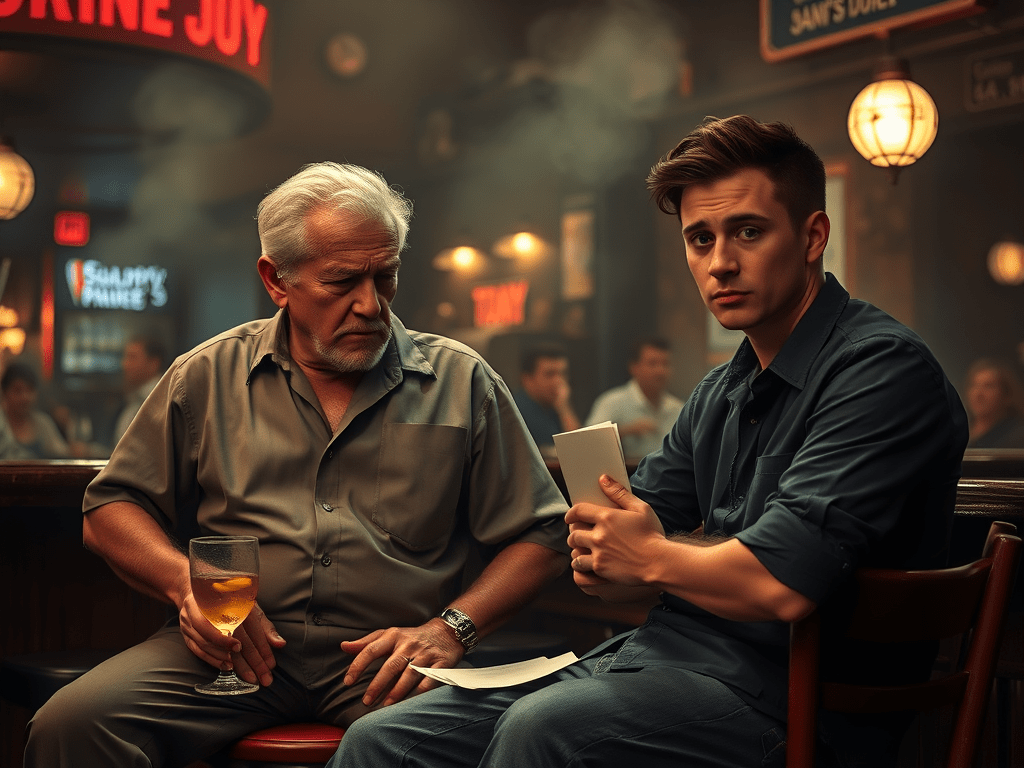
    The bar at Sloppy Joe’s was thick with smoke and the kind of heat that made your shirt stick to your back even at ten in the morning. Ernest sat at his usual spot, the corner stool where he could watch the door and the street beyond. The daiquiri in front of him was his second, but who was counting? The ice had melted into pale green water that tasted like disappointment.

    He’d been sitting there since eight, staring at the typewriter page he’d folded and stuck in his shirt pocket. Fifteen words. That’s all he’d managed yesterday. Fifteen goddamn words, and half of them were “the.”

    The young man walked in like he owned the place, which irritated Ernest immediately. He was maybe twenty-five, with that eager look of someone who hadn’t been kicked in the teeth by life enough times. His hair was perfectly combed, his shirt pressed. He looked like he’d never sweated through a shirt or bled on a page.

    “You’re Hemingway,” the kid said. Not a question.

    “I am.” Ernest didn’t look up from his drink.

    “I’m Danny Morrison. I write for—”

    “I don’t care who you write for.”

    But Danny slid onto the next stool anyway. He ordered a beer, which was smart. The bartender, Carlos, nodded approvingly. Carlos had strong opinions about men who ordered fancy drinks before noon.

    “I read your new story in Atlantic,” Danny said.

    Ernest’s hand tightened on his glass. The story Danny meant was “The Last Good Country,” and it was shit. Ernest knew it was shit, the editor knew it was shit, and apparently this kid knew it too.

    “And?”

    “It wasn’t your best work.”

    The bar went quiet. Not actually quiet—the fan still wheezed overhead, the radio still played Cuban music in the corner, and the fishermen at the far table still argued about bait. But something in the air shifted, like the moment before a storm hits.

    Ernest turned to look at Danny properly for the first time. The kid’s eyes were steady, not challenging exactly, but not backing down either. There was something familiar about that look. Ernest had seen it in mirrors, a long time ago.

    “What makes you think you know my best work from my worst?”

    “Because I’ve read everything you’ve ever published. Twice.”

    “Then you’ve wasted a lot of time.”

    Danny smiled, and it wasn’t the smile Ernest expected. It wasn’t cocky or nervous. It was sad.

    “You don’t believe that,” Danny said.

    “Don’t tell me what I believe, kid.”

    “Then don’t act like a has-been when you’re not.”

    The words hung between them like a challenge. Ernest could have gotten up and walked out. Could have thrown his drink in the kid’s face. Could have done any number of things that would have ended this conversation before it really started. Instead, he found himself curious.

    “You think you know me?”

    “I know your work. And I know what it’s like to sit at a typewriter and feel like a fraud.”

    Ernest laughed, but it came out bitter. “You’re twenty-five. What the hell do you know about being a fraud?”

    “More than you might think.” Danny took a long pull from his beer. “You want to know what I did yesterday? I wrote three thousand words. Good words. Real words. Words that said something true about what it means to be alive. Then I read them over and threw them all away.”

    “Why?”

    “Because they sounded like you.”

    Ernest studied the kid’s face. There was no accusation there, no blame. Just a statement of fact.

    “That’s not necessarily a bad thing,” Ernest said, though the words felt strange in his mouth.

    “It is if you’re not you.”

    They sat in silence for a while. Carlos refilled Ernest’s daiquiri without being asked. The fishermen settled their argument and left, trailing the smell of salt and diesel fuel. New customers trickled in—tourists mostly, loud and obvious in their vacation clothes.

    “I’ve been writing for thirty years,” Ernest said finally.

    “I know.”

    “Won won a Pulitzer. A Nobel Prize.”

    “I know that too.”

    “And yesterday I wrote fifteen words and they were all garbage.”

    Danny nodded like this made perfect sense. Like it was the most natural thing in the world for Ernest Hemingway to sit in a bar confessing his failures to a stranger.

    “What were the fifteen words?” Danny asked.

    Ernest pulled the folded paper from his pocket. He’d been carrying it around like evidence of his own inadequacy. He smoothed it out on the bar.

    The woman walked into the hotel bar and ordered whiskey like medicine.

    Danny read it twice, his lips moving slightly. Then he looked up at Ernest with something that might have been awe.

    “That’s not garbage.”

    “It’s obvious. Heavy-handed. A child could have written it.”

    “No,” Danny said quietly. “A child couldn’t have written it. Neither could I. And neither could most of the writers getting published these days.”

    Ernest wanted to argue, but something in Danny’s voice stopped him. There was a quality there he recognized—the sound of someone who’d spent enough time with words to know their weight.

    “You want to know what I think?” Danny continued. “I think you’re scared.”

    “Of what?”

    “Of not being as good as you used to be. Of writing something that doesn’t live up to the Ernest Hemingway brand.” Danny gestured at the bar around them, at the tourists who kept glancing over and whispering. “Of being mortal.”

    Ernest felt something hot and angry rise in his chest. “You don’t know what you’re talking about.”

    “Don’t I? You wrote For Whom the Bell Tolls twenty years ago. You wrote The Old Man and the Sea fifteen years ago. And every day since then, you’ve been trying to write something that good again. Every story gets measured against those. Every sentence. Every word.”

    “That’s what writers do. We try to get better.”

    “No,” Danny said. “That’s what scared writers do. Good writers just try to tell the truth.”

    He pulled out a notebook, worn and coffee-stained, and flipped through pages covered in cramped handwriting. “You want to see something? This is from yesterday, before I threw it all away.”

    He found the page he was looking for and read: “The young man sat at the typewriter and felt the weight of every great book ever written pressing down on his shoulders like stones.

    Ernest recognized the rhythm, the deliberate simplicity that masked complexity. It was good. It was also unmistakably influenced by his own style, but there was something else there too—something uniquely Danny.

    “Why did you throw it away?” Ernest asked.

    “Because it sounded too much like Hemingway. Because I was afraid people would say I was copying you. Because I was afraid you would read it and think I was copying you.”

    Ernest looked at his daiquiri. The ice had melted completely now, diluting the rum until it was barely colored water.

    “Can I tell you something?” he said. “When I wrote The Sun Also Rises, I was terrified it was just a cheap imitation of Gertrude Stein. When I wrote A Farewell to Arms, I was sure everyone would say I was trying to be Stephen Crane. And when I wrote For Whom the Bell Tolls, I spent half my time convinced I was a pretentious ass who had no business writing about war or Spain or anything else.”

    Danny stared at him. “Really?”

    “Really. You think the Nobel Prize committee calls you up and says, ‘Congratulations, you’re officially a real writer now, you can stop doubting yourself’? Hell, no. If anything, it makes it worse. Now everyone expects you to be Ernest Hemingway all the time. Even when you’re just a guy from Oak Park who happens to know how to string words together.”

    Ernest pulled out his own notebook and wrote something quickly. He tore out the page and handed it to Danny.

    The truth was this: every writer was a fake until the moment they stopped pretending to be anyone else.

    Danny read it and looked up. “Is that for your story?”

    “No,” Ernest said. “It’s for yours.”

    They finished their drinks in companionable silence. The bar filled with the lunch crowd—locals who nodded at Ernest but didn’t bother him, tourists who pointed but kept their distance. The normal rhythm of a Key West afternoon.

    Finally, Danny stood up and left money on the bar. “Thank you,” he said.

    “For what?”

    “For reminding me that even Ernest Hemingway used to be just Ernest.”

    After Danny left, Ernest sat alone for another hour. He thought about the fifteen words on the crumpled paper. The woman walked into the hotel bar and ordered whiskey like medicine. They weren’t garbage. They were the beginning of something true.

    He walked home through streets that smelled like fish and jasmine, past houses where bougainvillea climbed over fences and cats dozed in the shade. At his typewriter, he rolled in a fresh sheet of paper.

    The woman walked into the hotel bar and ordered whiskey like medicine. She had news to deliver and no good way to say it.

    The words came easier after that. Not because he’d stopped being afraid of failure, but because he’d remembered something more important: the fear meant he still cared. And caring, even when it hurt, was what separated the real writers from the ones who were just playing dress-up.

    By evening, he had two pages. Good pages. Not perfect pages, but honest ones. Pages that sounded like Ernest Hemingway not because he was trying to imitate himself, but because he was trying to tell the truth.

    That night, Carlos found him still at his corner stool, but this time he was writing in his notebook instead of staring at his drink.

    “Good day?” Carlos asked.

    Ernest looked up from his work. “Getting better.”

    “That young man who was here earlier—he came back looking for you.”

    “What did you tell him?”

    “That you went home to write.” Carlos grinned. “He said that was the best news he’d heard all day.”

    Ernest smiled back. Outside, the Key West sunset painted the sky in shades of pink and orange that no writer had ever adequately captured, though God knew they’d all tried. Tomorrow he would try too, and probably fail, and probably try again the day after that.

    But tonight, he had two pages of honest work and the knowledge that even fear could be a kind of fuel if you learned how to burn it properly.

    The truth was simple: there was no such thing as a real writer, only writers who kept writing despite feeling fake. The secret wasn’t conquering the doubt. The secret was making friends with it, inviting it to sit at the bar next to you, and buying it a drink while you worked.

    After all, everyone felt like an imposter sometimes. The trick was showing up anyway.

    One-Time
    Monthly
    Yearly

    Make a one-time donation

    Make a monthly donation

    Make a yearly donation

    Choose an amount

    $5.00
    $15.00
    $100.00
    $5.00
    $15.00
    $100.00
    $5.00
    $15.00
    $100.00

    Or enter a custom amount

    $

    Your contribution is appreciated.

    Your contribution is appreciated.

    Your contribution is appreciated.

    DonateDonate monthlyDonate yearly
  • The Salon of Scattered Thoughts: Virginia Woolf’s Battle with Digital Distraction

    The Salon of Scattered Thoughts: Virginia Woolf’s Battle with Digital Distraction

    The morning light filtered through the windows of the writing lodge at Monk’s House, casting long shadows across Virginia Woolf’s desk where pages of manuscript lay scattered like autumn leaves. She sat motionless, fountain pen suspended above the foolscap, her mind a peculiar battlefield where thoughts arrived and departed with the frantic energy of commuters at Victoria Station.

    *Ping.*

    The sound existed only in her imagination, yet it jolted her from the sentence she’d been constructing about Clarissa Dalloway’s morning walk. Where had that sound come from? There was no bell, no telephone, no servant approaching. Yet the phantom notification had shattered her concentration as surely as if someone had burst through the door shouting urgent news.

    She set down her pen and pressed her palms against her temples. This was the third time this morning that her attention had been hijacked by sounds that weren’t there, by the sensation that somewhere, somehow, something required her immediate response. It was as if her mind had become a drawing room where uninvited guests constantly arrived, each demanding acknowledgment, each fragmenting her thoughts into smaller and smaller pieces.

    The condition had begun subtly, perhaps a month ago. At first, she’d attributed it to the usual writerly anxieties—the fear that her work on *Mrs. Dalloway* was not progressing as it should, the worry that her experimental approach to narrative time was too radical for readers to follow. But this felt different. This felt like her very capacity for sustained thought was being eroded by some invisible force.

    She rose and walked to the window, observing the garden where Leonard was working among the roses. His movements were deliberate, unhurried—the embodiment of focused attention. How she envied him that quality now, when her own mind felt like a pond disturbed by too many stones.

    *Ping. Ping. Ping.*

    Three phantom sounds in rapid succession. Virginia gripped the windowsill, her knuckles white. The sounds seemed to come from everywhere and nowhere, accompanied by a compulsive need to… to what? To respond? To check something? But there was nothing to check, nowhere to respond to.

    She returned to her desk and attempted to resume writing, but the words that had once flowed like water now came in stuttering fragments. Each sentence felt interrupted before it could complete itself, as if her attention was a butterfly that could no longer alight on any single flower for more than a moment.

    The morning stretched on in this fashion—moments of clarity followed by sudden dispersal, thoughts that began with promise only to dissolve into anxiety about whether she was missing something important, something that required her attention elsewhere. By noon, she had managed only three sentences, each one wrung from her consciousness like water from a stone.

    Leonard appeared at the door with tea, his face creased with the particular concern he reserved for her difficult days. “How goes the work, my dear?”

    “It doesn’t,” she replied, gesturing at the nearly blank page. “My mind has become a railway station where all the trains arrive at once, and I can’t board any of them.”

    He set down the tea tray and settled into the chair beside her desk. “Tell me about it.”

    Virginia found herself describing the phantom sounds, the compulsive need to respond to non-existent summons, the way her concentration scattered like startled birds at the slightest provocation. As she spoke, she noticed how the act of articulating her experience seemed to give it shape, to make it less overwhelming.

    “It’s as if,” she said, warming to her theme, “as if my mind has become habituated to constant interruption. As if I’ve been living in a great, noisy house where bells ring constantly, and now, even in the silence of this room, I still hear them.”

    Leonard nodded thoughtfully. “You’ve been reading the newspapers more frequently of late. Following the political developments, the literary reviews, the society pages. Perhaps that’s contributing to the sense of… fragmentation?”

    The observation struck her as profoundly accurate. She had indeed been consuming information with unprecedented hunger in recent weeks—not just the essential news, but every detail, every commentary, every opinion. Her breakfast had become a feast of scattered facts and urgent opinions, each one demanding immediate assimilation.

    “But surely,” she protested, “a writer must be informed. Must know what’s happening in the world.”

    “Must she know everything that’s happening, the moment it happens?” Leonard asked gently. “Or might there be a difference between being informed and being… overwhelmed?”

    Virginia considered this. She thought of the great writers she admired—Jane Austen, who had created enduring art while living in relative isolation; George Eliot, who had absorbed the world deeply but selectively. Had they suffered from this same compulsive need to know everything immediately?

    “I think,” she said slowly, “I’ve been trying to hold the entire world in my mind at once. Every opinion, every event, every possible response. And my mind has become like a drawing room where everyone is talking at once, and no one can hear what anyone else is saying.”

    That afternoon, Virginia decided to conduct an experiment. She would attempt to write for one hour—sixty minutes—without allowing her attention to wander to anything beyond the immediate task. She would treat her consciousness like a room that she could choose to keep closed to uninvited guests.

    The first few minutes were torture. Her mind rebelled against the constraints, generating phantom urgencies and imaginary summons. But gradually, as she persisted in returning her attention to the page, something began to shift. The compulsive need to respond to non-existent calls grew quieter. The phantom sounds became less frequent.

    She found herself writing about Clarissa’s morning walk, but now the description was layered with her own recent experience. Clarissa, too, was navigating a world full of competing claims on her attention. The novel began to explore not just the flow of consciousness, but the way that consciousness could be fractured by too many simultaneous demands.

    As she wrote, Virginia realized she was discovering something important about the nature of attention itself. The mind, she saw, was not a passive recipient of whatever happened to arrive, but an active force that could be directed, disciplined, shaped. Like a skilled hostess, consciousness could choose which guests to admit to the drawing room and which to politely turn away.

    The hour passed without her noticing. When she finally looked up, she had written three full pages—more than she had managed in the entire morning. The words had a quality she hadn’t achieved in weeks: they were connected, flowing, alive with the particular rhythm that marked her best work.

    But more than that, she had discovered something about the relationship between attention and creativity. The scattered, anxious awareness that had plagued her morning was not a sign of intellectual vitality, but of intellectual dissipation. True creativity, she realized, required not just the ability to receive impressions, but the ability to select among them, to dwell with them, to allow them to develop and deepen.

    That evening, she walked in the garden with Leonard, sharing her discovery. “I think,” she said, “that I’ve been confusing being aware of everything with being truly aware of anything. I’ve been like someone trying to have a hundred conversations at once, and hearing none of them properly.”

    “And now?” Leonard asked.

    “Now I think I understand that attention is not a net to catch every passing thought, but a lamp to illuminate deeply whatever it chooses to shine upon. The art is not in capturing every possible impression, but in choosing which impressions deserve the full light of consciousness.”

    The next morning, Virginia established a new routine. She would begin each day not by consuming information, but by sitting quietly in the garden for ten minutes, allowing her mind to settle like silt in still water. She would read the newspaper, but only after her writing was complete, and only for a limited time. She would treat her consciousness as a precious resource to be allocated intentionally, rather than a receptacle to be filled indiscriminately.

    The phantom sounds—those imaginary notifications that had plagued her—began to fade. Not because the world had become less demanding, but because she had learned to distinguish between genuine calls for attention and the mind’s habitual restlessness. She had discovered that the stream of consciousness, to be truly explored, required not just sensitivity to impressions, but the discipline to dive deeply into selected currents rather than skimming frantically across the surface.

    Her work on *Mrs. Dalloway* resumed with renewed vigor. But now the novel carried within it a deeper understanding of the modern condition—the way that consciousness itself was under siege from the multiplying demands of an accelerating world. Through Clarissa’s experience, she would explore how the mind could maintain its integrity while remaining open to the richness of human experience.

    The drawing room of the mind, Virginia had learned, was most beautiful when it was neither empty nor overcrowded, but thoughtfully curated—a space where carefully chosen impressions could be received with the full hospitality of deep attention.

    —–

    *In the weeks that followed, Virginia’s writing took on a new depth and focus. She had learned that the modern writer’s greatest challenge was not finding material to write about, but learning to write despite the constant pressure to attend to everything at once. The solution was not to shut out the world, but to engage with it more selectively, more intentionally, more deeply.*

    One-Time
    Monthly
    Yearly

    Make a one-time donation

    Make a monthly donation

    Make a yearly donation

    Choose an amount

    $5.00
    $15.00
    $100.00
    $5.00
    $15.00
    $100.00
    $5.00
    $15.00
    $100.00

    Or enter a custom amount

    $

    Your contribution is appreciated.

    Your contribution is appreciated.

    Your contribution is appreciated.

    DonateDonate monthlyDonate yearly

    /

  • A New Constitution: Beyond Logic to Intuitive Governance

    A New Constitution: Beyond Logic to Intuitive Governance

    For the past 249 years, we have enjoyed a legacy created by men of great forethought and foresight. But the premises that guided the construction of that constitution no longer empower it, and it no longer serves us effectively.

    We must craft a new constitution. Could AI accomplish this task? Conceivably, but AI is limited by logical processes and whatever it can synthesize from knowledge pulled together from thousands of sources.

    I believe we need to find men and women with not only great forethought and foresight, but also profound intuition—individuals who can craft a new constitution that will enable us to avoid the disastrous shortcomings and pitfalls we are experiencing today.

    This select group of men and women must possess highly developed intuition. Intuition is a powerful sixth sense that I’m certain cannot be emulated by AI. Perhaps imitated, but never perfectly replicated. It’s the kind of intuition that can only be developed and perfected through deep meditation. The human mind has its limitations, but through meditation, one can connect with the Divine mind that has no limitations.

    Paramahansa Yogananda wrote and spoke volumes about developing the kind of intuition that could see into the infinite—far beyond our known and imagined view of the universe, encompassing any anticipated and unanticipated events, possibilities, and circumstances that could evolve. This new, metaphysically ordained constitution could perhaps enable us to maintain an equitable international peace for more than several hundred years.

    Perhaps that select group of men and women are already working to devise a way out of this challenging dilemma.

    —–

    *What are your thoughts on the role of intuition versus logic in governance? How might we balance technological capabilities with human wisdom in shaping our future?*

    #Constitution #Governance #Leadership #Meditation #Intuition #FutureOfDemocracy